Are You Drinking Microplastics Every Day?
Microplastics have been detected in air, rain, and snow, showing they are now part of the global environment. This article explores how microplastics travel through atmospheric systems and what current research reveals about everyday exposure.
Microplastics in Air, Rain, and Snow Explained
Part 1 of the ecotanka Microplastics Series
Introduction
Most people think of plastic pollution as something visible — bottles on beaches, packaging in landfills, or debris floating in rivers.
But over the past decade, environmental research has revealed something far less visible and far more widespread:
Microplastics are now present in the air we breathe, the rain that falls, and even the snow that covers remote environments.
This changes the way we understand exposure.
Microplastics are no longer just a waste management issue.
They are now part of the global environmental cycle.
What Are Microplastics?
Microplastics are small plastic particles generally defined as pieces of plastic less than 5 millimetres in size.
They are often invisible to the naked eye and can come from the breakdown of larger plastic materials or from industrial sources.
Once released into the environment, these particles can persist and travel through air, water, and soil systems.
How Microplastics Enter the Environment
Microplastics are formed through the gradual breakdown of plastic materials exposed to:
- Sunlight (UV radiation)
- Wind and weathering
- Mechanical friction
- Temperature changes
- Physical abrasion
As larger plastic items degrade, they fragment into smaller and smaller pieces.
Over time, these fragments can become light enough to be transported through the air.
Microplastics in the Atmosphere
Recent environmental observations and scientific reporting show that microplastic particles are not limited to oceans or landfills.
They can also be found in the atmosphere.
Once airborne, these particles can:
- Travel long distances
- Circulate through wind systems
- Remain suspended for extended periods
- Settle far from their original source
This means microplastics are not just a local pollution issue — they are a global airborne contaminant.
People are now exposed not only through direct contact with plastic products, but also through everyday environmental exposure to air and dust.
Microplastics in Rainfall
One of the most significant environmental findings in recent years is the presence of microplastic particles in rainwater.
This indicates that microplastics are being:
- Lifted into the atmosphere
- Transported through air currents
- Returned to the earth through precipitation
Rain is no longer just a clean water cycle from evaporation and condensation.
It now also acts as a delivery system for atmospheric particles, including microplastics.
This means plastic pollution is cycling through the environment in a continuous loop.
Microplastics in Snow
Research has also identified microplastic particles in snowfall.
This is important because snow forms in colder atmospheric conditions and often in regions far away from urban or industrial plastic sources.
The presence of microplastics in snow demonstrates that:
- Plastic particles can travel long distances through the atmosphere
- Remote environments are not protected from contamination
- Atmospheric transport is a global phenomenon
Even isolated regions can receive microplastic deposition through snowfall.
This reinforces the idea that microplastics are now part of planet-wide atmospheric movement.
“Falling from the Sky” – What It Actually Means
Some environmental observations describe microplastic particles being collected from atmospheric fallout.
This does not mean plastic is being generated in the sky.
Instead, it reflects a natural cycle of movement:
Plastic materials break down on land and water
Tiny particles become airborne
Wind systems transport them through the atmosphere
Particles eventually settle through rain, snow, or dust
In simple terms:
The atmosphere has become part of the distribution system for microplastics.
This is one of the most important shifts in understanding modern pollution.
Why This Changes Everything
Traditionally, plastic pollution was seen as a visible problem:
- bottles
- packaging
- waste in oceans and rivers
But atmospheric findings show a different reality:
Microplastics are now:
- in the air
- in rainfall
- in snow
- part of global circulation systems
This means exposure is not limited to obvious contact with plastic materials.
It is now part of the environment itself.
Exposure Pathways in Everyday Life
Based on atmospheric findings, microplastic exposure can occur through multiple pathways:
1. Inhalation
Airborne particles can be inhaled during normal daily activity.
2. Water exposure
Rainwater and surface water systems can carry microplastic particles.
3. Environmental dust
Settled particles can mix with household and outdoor dust.
This creates multiple overlapping exposure routes, even in everyday environments that appear clean.
Why Scientists Are Paying Attention
The discovery of microplastics in air, rain, and snow is important because it expands the known scale of plastic pollution.
It shows that microplastics are not confined to waste sites or oceans — they are now part of environmental systems that affect all regions.
This has led to increased scientific focus on:
- how far particles travel
- how they move through atmospheric systems
- how widely they are distributed across ecosystems
However, many questions remain under active investigation.
What Is Still Not Fully Understood
While environmental presence is well documented in the sources used for this article, several important areas are still being studied:
- The long-term health effects of inhaling microplastics
- The full impact of ingestion through water and food
- The behavior of extremely small particles in the human body
- Safe exposure thresholds (if any exist)
At present, the research confirms presence and distribution, but not fully defined health outcomes.
Why This Matters for Drinking Water Awareness
Because microplastics are now present in the atmosphere, they can enter water systems through multiple pathways:
- rainfall contamination
- surface water exposure
- environmental deposition
This means that drinking water systems exist within a broader environmental context where microplastics are already present.
It is not a single-source issue — it is part of a wider environmental cycle.
Key Takeaways (SEO + Featured Snippet Ready)
- Microplastics are present in the atmosphere
- They have been detected in rain and snowfall
- Atmospheric movement distributes them globally
- Exposure occurs through air, water, and environmental contact
- Microplastics are now part of the environmental cycle, not just waste systems
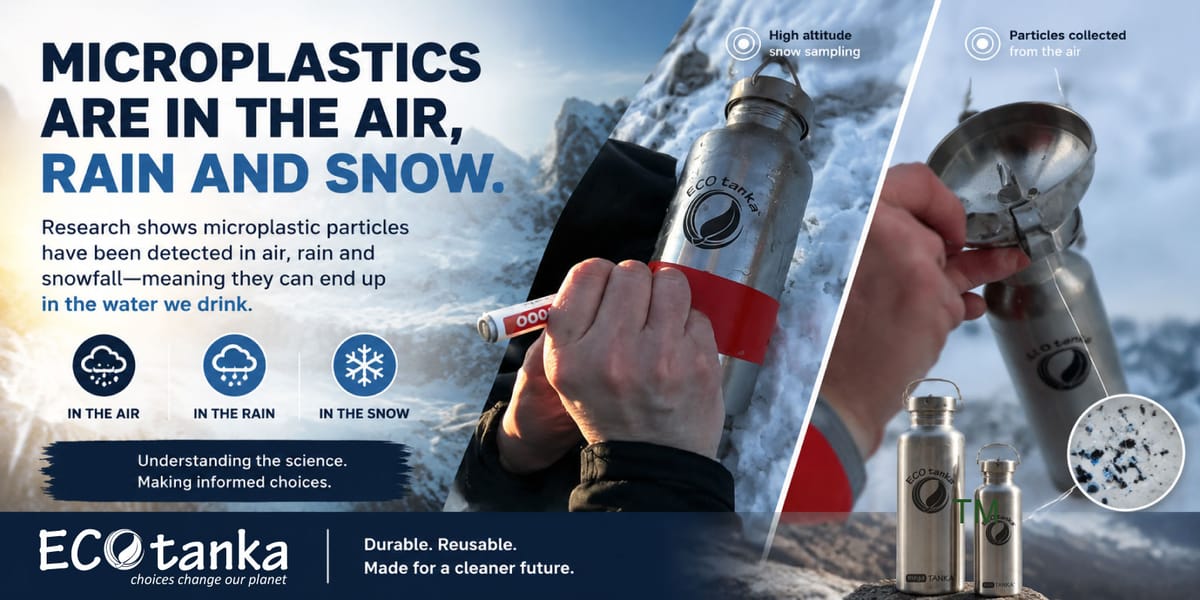
Microplastics falling from the sky (Arctic snow / BBC report)
Title (SEO-friendly):
Microplastics Found Falling with Snow in the Arctic
Suggested caption (important for SEO):
Scientific and media footage showing microplastic particles collected in Arctic snow, supporting research that microplastics are transported through the atmosphere and deposited via snowfall.
Scientist demonstrating microplastics using ECOtanka bottle (Tagesschau TV)
Title (SEO-friendly):
German Scientists Demonstrate Atmospheric Microplastics Using Water Collection
Suggested caption (important for SEO + brand positioning):
Television footage showing scientific sampling of atmospheric particles using an ECOtanka megaTANKA bottle, illustrating how microplastics can be collected from air and environmental precipitation.
FAQ Section (Optimized for Google AI Overview)
Are microplastics in the air?
Yes. Environmental research shows that microplastic particles can become airborne and circulate through the atmosphere.
Do microplastics fall with rain and snow?
Yes. Studies have found microplastic particles in both rainfall and snowfall, indicating atmospheric transport and deposition.
Can microplastics travel long distances?
Yes. Atmospheric movement allows microplastics to be transported far from their original source areas.
Is microplastic exposure avoidable?
Complete avoidance is not currently possible because microplastics are present in multiple environmental systems including air, water, and dust.
Conclusion
Microplastics are no longer confined to visible pollution sites.
They are now part of the atmospheric and environmental systems that surround us every day — appearing in air, rain, and snow across the world.
While research is still evolving, the evidence from environmental observations confirms one important reality:
Microplastics are now part of the modern environment, not just the waste stream.
References & Source Material
The following sources were used to inform environmental observations and scientific reporting referenced in this article:
BBC News – Science & Environment
Title: Microplastics found in remote mountain air and rainfall
Source: BBC News – Science & Environment
Link: https://www.bbc.com/news/science-environment-49295051
Relevance:
Reports on the detection of microplastic particles in atmospheric samples, including air and precipitation, demonstrating that microplastics are now present in the global atmosphere and can be transported long distances.
Microplastics Prevail in Snow (Research PDF)
Title: Microplastics prevail in snow
Type: Scientific research paper / environmental study (PDF)
Relevance:
Documents the presence of microplastic particles in snow samples, supporting the conclusion that microplastics are transported through the atmosphere and deposited in cold and remote environments via snowfall.
Atmospheric Plastic Deposition Study (BBC-supported findings)
Title: Plastic particles falling from the sky (environmental observation / reporting)
Type: Environmental observation and reporting (video reference provided)
Relevance:
Visual and observational evidence supporting the concept of atmospheric microplastic transport and deposition, showing that plastic particles can be carried in air currents and returned to earth through rain and dust.
General Environmental Monitoring Literature (Referenced Summary Source)
Title: Microplastic atmospheric transport and deposition (reviewed findings)
Type: Aggregated scientific understanding based on environmental monitoring studies
Relevance:
Supports the broader scientific consensus that microplastics are now found in multiple environmental compartments including air, precipitation, and remote ecosystems, indicating global atmospheric distribution.
Supporting Visual Material
Title: Plastic particles falling out of the sky (video material)
Type: Environmental visual documentation
Relevance:
Used to support the concept of atmospheric microplastic movement and deposition processes, aligning with scientific observations of airborne transport and precipitation-based return to earth.