Microplastics in Tap Water: What Is Coming Out of Your Tap?
Microplastics have been detected in tap water around the world. We examine research from 2017 to 2026, where the particles may come from, what water treatment removes, and what scientists are discovering about nanoplastics.
Part 3 of the ecotanka Microplastics Series
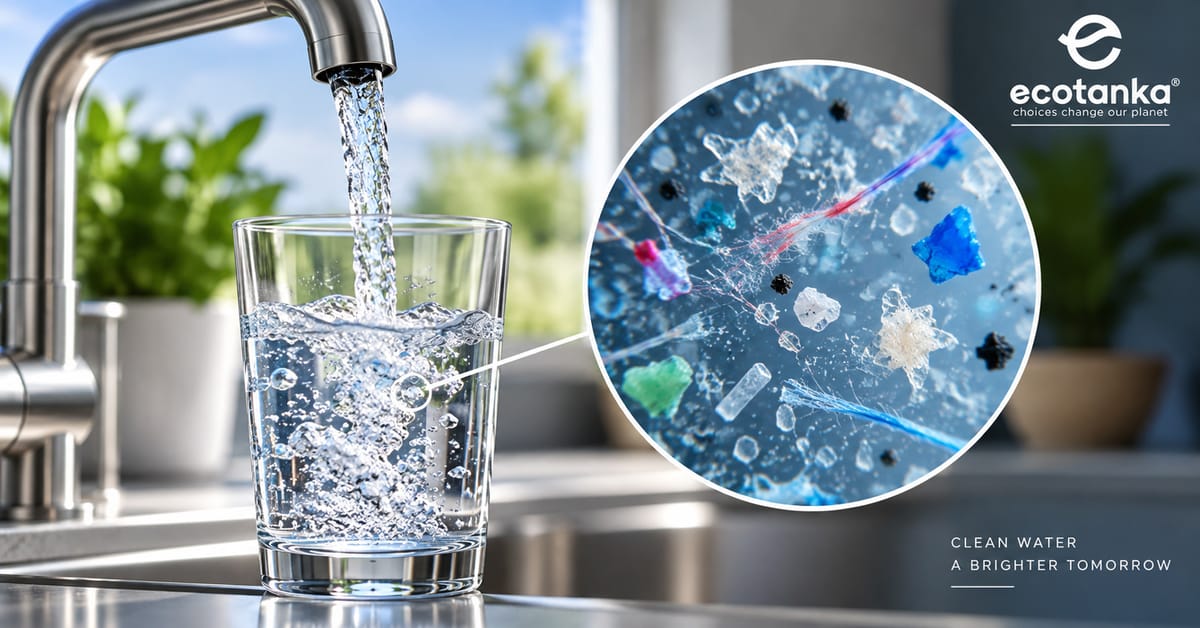
Turn on a tap, fill a glass, and the water looks perfectly clear.
But research conducted around the world has found that drinking water can contain something we cannot see:
microplastics.
This isn't a new discovery. An international investigation almost a decade ago reported plastic fibres in tap-water samples from countries around the world.
Since then, scientists have developed better methods for identifying increasingly small particles. A major 2025 systematic review brought together decades of research and concluded that microplastics are indeed widespread in tap water — while also highlighting just how difficult they are to measure consistently.
So what is actually coming out of our taps?
Where do these particles come from?
And perhaps most importantly:
Does modern water treatment remove them?
The Investigation That Brought Worldwide Attention to Tap Water
In 2017, Orb Media commissioned an investigation into microplastics in drinking water.
Researchers examined 159 tap-water samples from countries around the world.
Plastic fibres were reportedly detected in 83% of the samples.
The United States had the highest reported contamination rate at 94%, while European countries included in the investigation had a reported rate of 72%.
The average number of fibres was also reported to differ:
United States — 4.8 fibres per 500 ml
Europe — 1.9 fibres per 500 ml
At the time, the findings generated worldwide attention.
Plastic pollution was already recognised as an enormous problem in oceans.
Finding microscopic plastic fibres in something as ordinary as a glass of tap water made the issue suddenly much closer to home.
But there was an important limitation.
The Early Research Couldn't See Everything
Studying microplastics is surprisingly difficult.
Researchers need to collect samples without accidentally introducing plastic contamination from clothing, laboratory equipment or the surrounding environment.
Then they need to determine whether a tiny particle is actually plastic.
And perhaps most importantly, they need equipment capable of detecting particles that may be only a few micrometres across.
This has created a major problem when comparing studies.
Different researchers have:
- collected different volumes of water
- looked for different particle sizes
- used different filtration methods
- used different analytical technologies
- applied different quality-control procedures
A 2020 systematic review concluded that methodological differences were so substantial that a conventional meta-analysis of the available drinking-water studies wasn't appropriate. The minimum particle size examined in different studies ranged from 1 to 100 micrometres, dramatically affecting how many particles researchers could detect.
In simple terms:
The smaller the particles your equipment can see, the more plastic you may find.
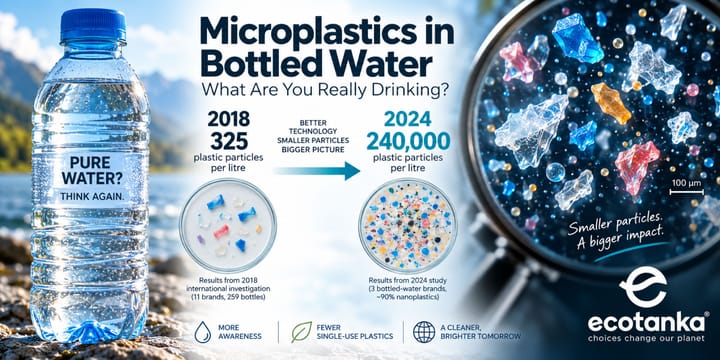
We saw exactly the same issue in Part 2 of this series — Microplastics in Bottled Water.
What Does the Newer Research Show?
By 2025, there was enough research for scientists to undertake a much larger systematic review specifically examining microplastics in tap water.
Researchers searched thousands of scientific papers and ultimately included 43 studies in their systematic review.
Thirty-six studies had suitable data for the meta-analysis.
Their pooled estimate was:
56.98 microplastic particles per litre of tap water
with a 95% confidence interval of approximately 26.31 to 87.65 particles per litre.
That sounds like a wonderfully precise answer.
Unfortunately, it isn't quite that simple.
The researchers found substantial differences between studies and specifically warned that the lack of harmonised sampling and analytical methods makes results difficult to compare reliably.
So 56.98 particles per litre should not be interpreted as what comes out of every tap.
Tap-water systems differ.
Source waters differ.
Treatment systems differ.
Distribution networks differ.
And laboratory methods differ.
The number is more useful as evidence that microplastics are being repeatedly detected across the scientific literature than as a universal concentration for tap water.
What Types of Microplastics Are Found in Tap Water?
The 2025 systematic review also provides a much clearer picture of what researchers are finding.
The dominant forms were:
fibres and fragments.
The most commonly identified polymers were:
Polyethylene (PE)
Polyethylene terephthalate (PET)
Polypropylene (PP)
Another interesting finding concerned particle size.
Particles smaller than 50 micrometres were reported in more than 70% of the studies that provided relevant size information.
That raises an obvious question.
If water-treatment systems remove many larger particles, are the particles we're finding at the tap disproportionately the smaller ones that remain?
The evidence suggests this may be part of the story.
Where Do Microplastics in Tap Water Come From?
There isn't one single source.
Microplastics are now distributed throughout the environment.
Plastic waste breaks down.
Synthetic textiles release fibres.
Tyres and other materials release particles through abrasion.
Wastewater carries plastic particles.
Plastic can enter rivers, lakes and groundwater.
And, as we explored in Part 1 — Are You Drinking Microplastics Every Day?, microplastics can even be transported through the atmosphere before being deposited through rain, snow and atmospheric fallout.
The World Health Organization identifies several pathways by which microplastics can enter freshwater sources, including surface run-off and wastewater effluent. WHO's drinking-water assessment examines microplastics across the entire water cycle rather than treating tap water as an isolated source of contamination.
But there is another possible source much closer to the tap itself.
The Water Distribution System May Also Play a Role
Water doesn't travel directly from a river or reservoir into your glass.
It passes through treatment facilities.
Then through kilometres of distribution infrastructure.
Pipes, pumps, valves, seals and other components can all form part of that system.
A 2024 systematic review examining microplastics and nanoplastics in water-treatment processes identified the water-supply system itself as a potential source of microplastics in tap water.
This makes the question of where an individual particle originated surprisingly complicated.
A particle coming from your tap might have originated in the source water.
It might have survived treatment.
Or it could potentially have entered the water somewhere within the treatment or distribution system.
That means detecting microplastics at the tap doesn't necessarily tell us where those particles began their journey.
Doesn't Water Treatment Remove Microplastics?
Yes — it can remove a substantial proportion of them.
This is an important part of the story because saying “microplastics have been found in tap water” can easily create the impression that water treatment isn't working.
That would be misleading.
WHO's assessment found that properly operated wastewater and drinking-water treatment systems can remove microplastics, with wastewater treatment capable of removing more than 90% in some circumstances and the highest removal associated with tertiary treatment such as filtration.
Processes used in drinking-water treatment can include combinations of:
coagulation → flocculation → sedimentation → filtration → disinfection
These processes weren't necessarily designed specifically to remove microplastics.
But many of them remove particles from water, and microplastics can be removed along with other particulate material.
More recent research continues to examine how different technologies perform. A 2024 systematic review analysed studies involving 26 water-treatment plants across 12 countries and found that removal performance depends on the treatment technology and characteristics of the particles involved.
The Smallest Particles Are the Biggest Challenge
Size matters.
Larger particles are generally easier to capture.
As particle size decreases, detection and removal become more difficult.
A comprehensive 2026 review concluded that conventional treatment remains an important foundation for microplastic removal but can struggle particularly with particles smaller than 10 micrometres.
And then there are particles smaller still.
Nanoplastics.
These are generally particles below approximately one micrometre.
They are extraordinarily small.
For comparison, a human hair is roughly tens of micrometres across.
Nanoplastics can therefore be many times smaller than the width of a human hair.
This isn't merely a treatment problem.
It's also a measurement problem.
For years, much of the scientific equipment used in microplastics research simply wasn't capable of reliably identifying plastics at this scale.
2026: Scientists Looked at Microplastics AND Nanoplastics in Drinking Water
This is where the latest research becomes particularly interesting.
Researchers at Ohio State University compared conventionally treated municipal drinking water with bottled water using technology capable of identifying much smaller particles than many previous studies.
Their research was published in the January 2026 issue of Science of the Total Environment.
More than:
50% of the particles detected were nanoplastics
in both bottled and treated drinking water.
The researchers concluded that earlier studies probably underestimated micro- and nanoplastic concentrations because nanoplastics were often excluded from measurements.
That's an important development.
It doesn't mean water suddenly contains more plastic.
It means scientists are becoming better at detecting particles that were previously extremely difficult to see.
Tap Water or Bottled Water: Which Had More?
This gives us a direct connection to Part 2 — Microplastics in Bottled Water.
In the 2026 comparison, researchers found that:
bottled water had higher particle concentrations than conventionally treated municipal drinking water.
Interestingly, the study found that the mass concentrations were not significantly different, even though bottled water contained more particles.
How can that happen?
Because particle number and particle mass are not the same measurement.
A large number of extremely tiny particles can have less total mass than a much smaller number of larger particles.
This is another reason headlines about microplastic particle counts need to be interpreted carefully.
The researchers also identified rubber in every water sample they analysed, suggesting that elastomeric particles may be an overlooked component of micro- and nanoplastic contamination in drinking water.
The study does not prove that tap water everywhere contains fewer microplastics than bottled water.
But it does challenge the assumption that buying water in a disposable plastic bottle automatically provides protection from plastic particles.
Should You Stop Drinking Tap Water?
No — that isn't what this research says.
This is perhaps the most important section of this article.
Microplastics are an emerging environmental contaminant.
Pathogenic microorganisms and established chemical contaminants in unsafe drinking water are well-understood health hazards.
WHO has therefore explicitly cautioned that water suppliers and regulators should continue prioritising contaminants with known human-health risks, particularly microbial pathogens and harmful chemicals.
That is an important perspective.
It would make little sense to avoid a well-managed municipal drinking-water supply because of uncertain microplastic risks and instead consume microbiologically unsafe water.
The presence of microplastics deserves research.
But it needs to be considered within the much broader subject of drinking-water safety.
What About Home Water Filters?
This is where we need to be careful.
Not every household filter removes the same contaminants.
Different systems use very different technologies, including activated carbon, membrane filtration and reverse osmosis.
Some filtration technologies can remove very small particles effectively, but performance depends on the filter design, pore size, condition, installation and maintenance.
Research also raises an interesting complication: filtration systems themselves can contain polymer components.
So it would be irresponsible for us to simply say:
“Buy a filter and you'll remove microplastics.”
The evidence isn't that simple.
If reducing particulate contamination is important to you, look for independently tested filtration performance and understand exactly what the particular system has been designed and certified to remove.
Does Boiling Tap Water Remove Microplastics?
This is another question appearing increasingly often.
Boiling water is extremely useful for controlling many microbial hazards.
But microplastics aren't living organisms.
Simply heating a plastic particle doesn't make it disappear.
There has been emerging research investigating whether boiling hard water can cause minerals such as calcium carbonate to encapsulate some microplastics, allowing them to be removed with the mineral deposits.
That's interesting research, but it is not equivalent to saying that boiling universally removes microplastics from drinking water.
Water chemistry matters, particle size matters and the method used after boiling matters.
For now, we would not recommend treating ordinary boiling as a guaranteed microplastic-removal method.
Are Microplastics in Tap Water Dangerous to Human Health?
We need to make exactly the same distinction we made in Part 2.
There are two separate questions:
Are microplastics present in tap water?
The scientific evidence shows that they have repeatedly been detected.
Does drinking tap water containing microplastics cause human disease?
That has not been established.
Research into potential human-health effects is developing rapidly, particularly as scientists investigate smaller microplastics and nanoplastics.
WHO has repeatedly called for better analytical methods, better exposure data and further research into possible health effects.
And some of the newest discoveries go far beyond drinking water.
Researchers have now reported micro- and nanoplastics in human tissues, including blood vessels and brain tissue.
Those findings deserve their own article rather than a few alarming paragraphs here.
That's exactly what we'll investigate in Part 4 of this series — Microplastics in the Human Body.
Tap Water Is Only Part of a Much Bigger Cycle
The most important lesson from all this research may not actually be about taps.
Think about the journey.
Plastic enters the environment.
It fragments.
Particles enter soil and waterways.
Fibres become airborne.
Microplastics fall with rain and snow.
Wastewater carries particles into treatment systems and waterways.
Water is collected and treated.
Many particles are removed.
Some extremely small particles may remain.
Water travels through distribution systems.
And eventually:
we turn on the tap.
That's why treating microplastics solely as a drinking-water problem misses the bigger issue.
They are an environmental plastic pollution problem.
Reducing the Problem at the Source
Better water treatment can help.
Better wastewater treatment can help.
Improved filtration technologies can help.
Better analytical methods will help scientists understand what we're actually exposed to.
But removing microscopic plastic after it has entered the environment is an extraordinarily difficult way to solve the problem.
Preventing unnecessary plastic from entering the environment in the first place makes considerably more sense.
WHO has likewise called for reductions in plastic pollution while continuing research into the health implications of microplastics.
That means reducing unnecessary single-use plastics.
Improving waste collection.
Improving recycling.
Reducing plastic leakage into waterways.
And choosing durable reusable products where appropriate.
Where Does a Reusable Stainless Steel Bottle Fit In?
A stainless steel bottle doesn't remove microplastics from tap water.
If plastic particles are already present in the water you put into a bottle, changing the bottle doesn't magically make them disappear.
We think that's important to say clearly.
What a reusable bottle can do is remove one unnecessary part of the cycle:
the repeated use and disposal of single-use plastic water bottles.
ecotanka bottle bodies are manufactured from 18/8 Type 304 stainless steel without a plastic lining or internal plastic coating.
Some ecotanka lids contain polypropylene components and silicone seals, while stainless steel lid options are available for selected products.
Our approach isn't about pretending we can eliminate every piece of plastic from modern life.
It's about asking a much simpler question:
Where can we use less?
The Bottom Line
Microplastics have been detected in tap water around the world.
An early international investigation reported plastic fibres in 83% of the tap-water samples examined.
Years of subsequent scientific research have confirmed that microplastics can occur in treated drinking water.
A major 2025 systematic review and meta-analysis estimated a pooled mean of approximately 57 microplastic particles per litre, while also warning that substantial methodological differences make comparisons between studies difficult.
And in 2026, researchers using technology capable of examining much smaller particles found that more than half of the particles they detected in both bottled and treated drinking water were nanoplastics.
The science has therefore changed considerably since that first 2017 investigation.
Not necessarily because our water suddenly contains more plastic.
But because:
we are getting much better at seeing it.
The unanswered question is what long-term exposure to these particles means for the human body.
And that is where this series goes next.
ecotanka Microplastics Series
Part 1 — Are You Drinking Microplastics Every Day?
Microplastics in air, rain and snow.
Part 2 — Microplastics in Bottled Water: What Are You Really Drinking?
Microplastics, nanoplastics, PET bottles and what improved detection technology has revealed.
Part 3 — Microplastics in Tap Water: What Is Coming Out of Your Tap?
You are here.
Coming next — Part 4: Microplastics in the Human Body
What scientists have found in human tissues, including blood vessels, arteries and the brain — and what those findings do and do not prove.
References & Further Reading
1. Malekzadeh M, Dehghanzadeh R, Ebrahimi SM, et al. (2025).
Occurrence, sampling, identification and characterization of microplastics in tap water: A systematic review and meta-analysis.
Ecotoxicology and Environmental Safety, 299, 118347.
DOI: 10.1016/j.ecoenv.2025.118347
The review included 43 studies and reported a pooled mean of 56.98 microplastic particles per litre while highlighting major methodological differences between studies.
2. Danopoulos E, Twiddy M, Rotchell JM. (2020).
Microplastic contamination of drinking water: A systematic review.
PLOS ONE, 15(7), e0236838.
DOI: 10.1371/journal.pone.0236838
An earlier systematic assessment that highlighted the large differences in analytical methods and particle-size detection limits used in drinking-water research.
3. Romphophak P, Faikhaw O, Sairiam S, et al. (2024).
Removal of microplastics and nanoplastics in water treatment processes: A systematic literature review.
Journal of Water Process Engineering, 64, 105669.
DOI: 10.1016/j.jwpe.2024.105669
Examines micro- and nanoplastic removal through water-treatment processes and the potential contribution of water-supply systems themselves.
4. Jamison Hart MN, Lenhart JJ. (2026).
What's in your water? A comparative analysis of micro- and nanoplastics in treated drinking water and bottled water.
Science of the Total Environment, 1011, 181148.
DOI: 10.1016/j.scitotenv.2025.181148
Compared bottled and conventionally treated drinking water using analytical methods capable of detecting nanoplastics. More than half of detected particles were nanoplastics, and bottled water had higher particle concentrations in the samples studied.
5. World Health Organization (2019).
Microplastics in Drinking-Water.
World Health Organization, Geneva. ISBN 978-92-4-151619-8.
WHO's major assessment of microplastics across the water cycle, including occurrence, treatment, potential health implications and research gaps.
6. Bodzek M, Pohl A. (2026).
Micro- and nanoplastics in drinking water: the review.
Archives of Environmental Protection, 52(2).
DOI: 10.24425/aep.2026.1295
A current review covering occurrence in source, treated and bottled water and the performance of different drinking-water treatment processes.
7. Orb Media (2017).
Invisibles: The Plastic Inside Us.
International tap-water investigation involving 159 samples. This was an early media-led investigation rather than the type of peer-reviewed systematic research represented by the later studies above, so its findings should be interpreted in that context.