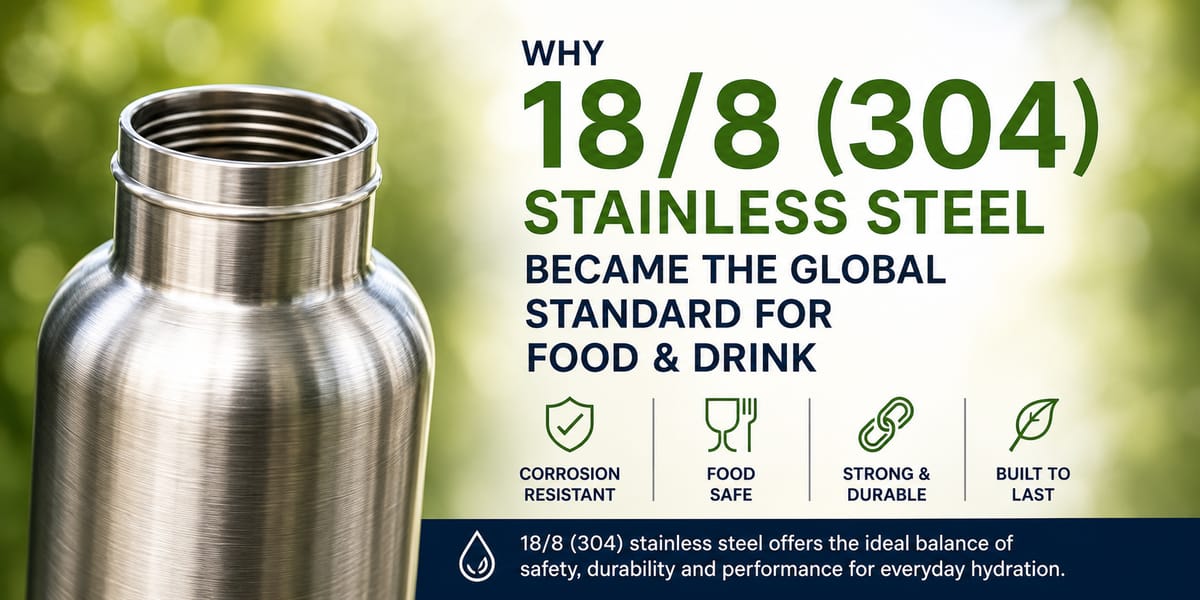
Why 18/8 (304) Stainless Steel Became the Global Standard for Food and Drink
Why do premium reusable bottles use 18/8 (304) stainless steel? Discover what the numbers mean, how different stainless steel grades compare, and why 304 has become the world's most trusted material for food and drink.
What 18/8 really means, how it compares with 316 and 201 stainless steel, and why quality matters in your reusable drink bottle.
When shopping for a reusable drink bottle, you'll often see terms like 18/8 stainless steel, 304 stainless steel, or simply food-grade stainless steel.
Manufacturers frequently mention these terms, but rarely explain what they actually mean.
Is 18/8 better than other stainless steels?
What makes 304 different from 316 or 201?
And why has 18/8 (304) become the material trusted by hospitals, commercial kitchens, breweries, food manufacturers and millions of reusable bottle users around the world?
The answer lies in the unique balance of corrosion resistance, durability and long-term performance that 304 stainless steel offers.
What Does 18/8 Mean?
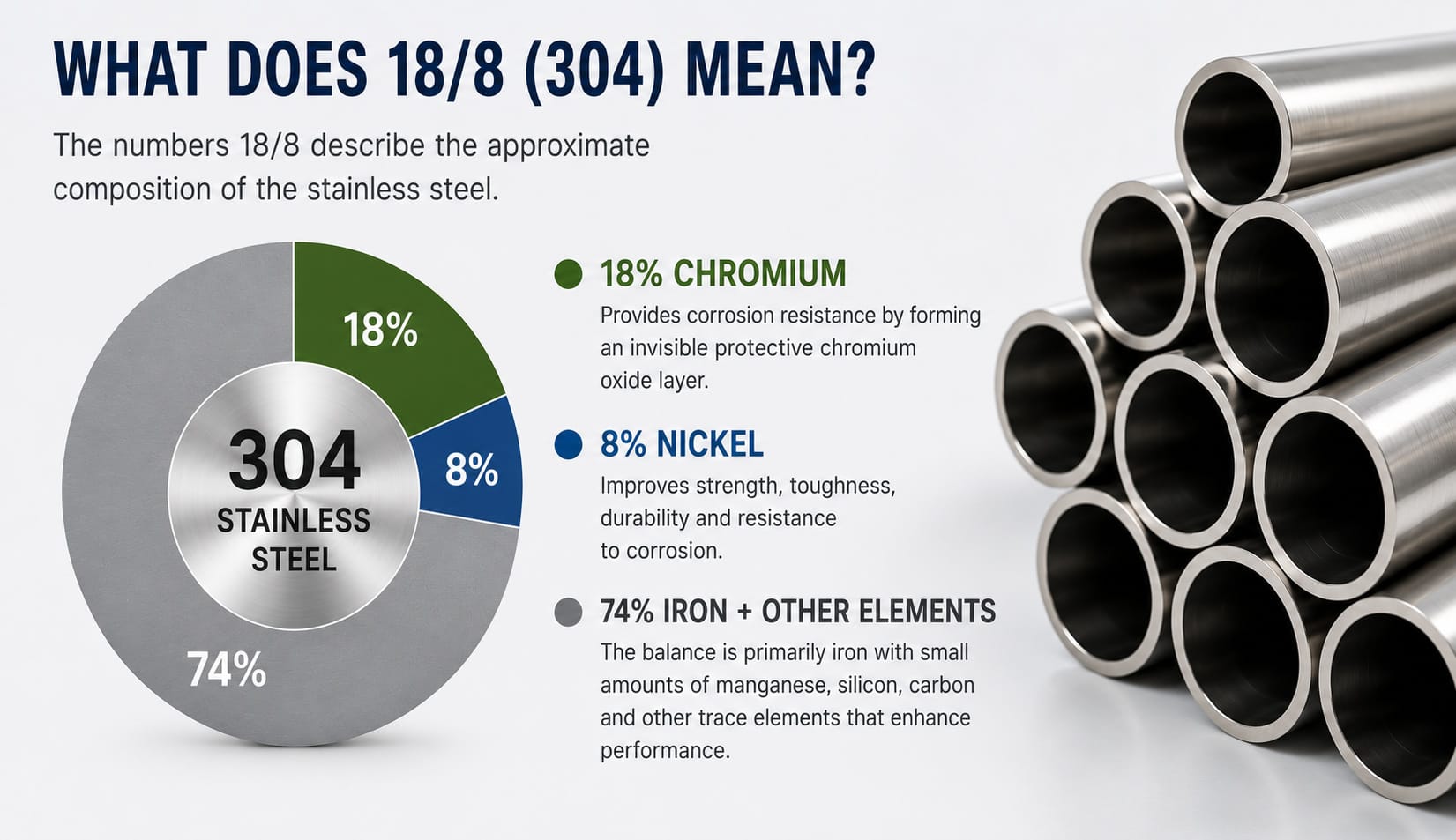
The numbers 18/8 describe the approximate composition of the stainless steel.
- 18% Chromium
- 8% Nickel
- The remaining balance is primarily iron, along with small amounts of other alloying elements such as manganese, silicon and carbon.
These two primary alloying elements each perform an important role.
Chromium provides corrosion resistance by forming a protective passive chromium oxide layer.
Nickel improves durability, toughness and long-term corrosion resistance while making the steel easier to form during manufacturing.
Together, they create one of the world's most versatile and widely used stainless steel alloys.
Why Chromium Is So Important
Chromium is the ingredient that gives stainless steel its remarkable corrosion resistance.
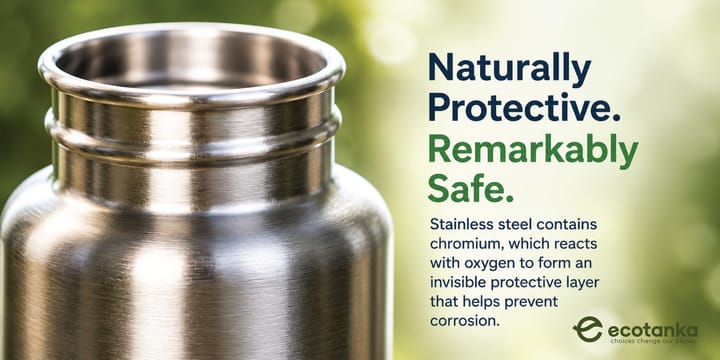
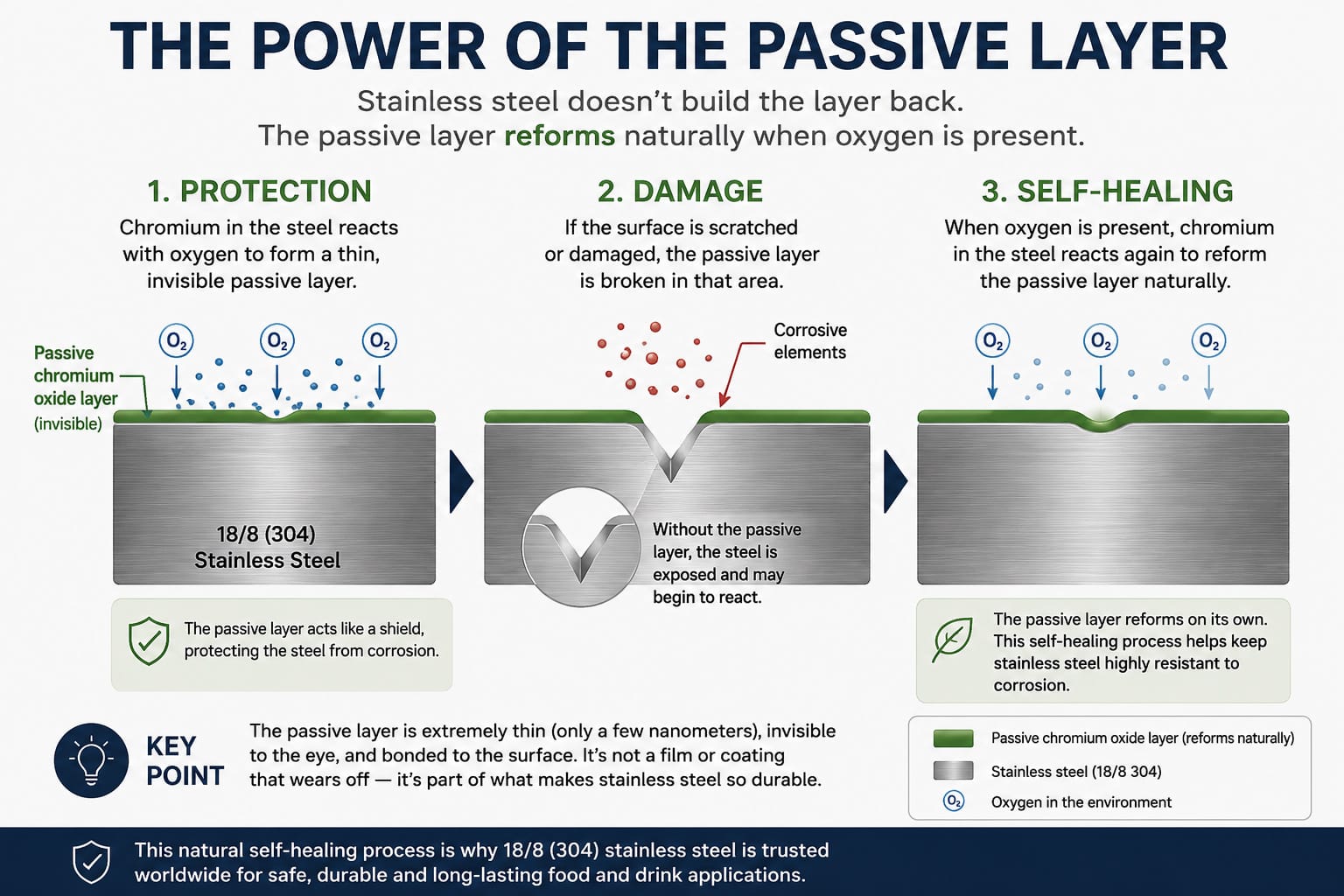
When exposed to oxygen, chromium naturally forms an invisible chromium oxide layer across the surface of the steel.
Although only a few nanometres thick, this passive layer protects the metal underneath from corrosion.
If the surface is lightly scratched, the passive layer naturally reforms when oxygen is present—a process known as repassivation.
This self-healing property is one of the reasons stainless steel has become such a trusted material for food and beverage applications.
(If you'd like to learn more about passivation, read our article: How Safe is Stainless Steel?)
What Does Nickel Do?
Nickel is often misunderstood.
It is not added simply because it sounds impressive.
Nickel improves several important properties of stainless steel:
- Greater corrosion resistance
- Improved toughness
- Better resistance to cracking
- Easier manufacturing and forming
- Improved long-term durability
Together with chromium, nickel helps create the balance of strength and corrosion resistance that has made 304 stainless steel so widely used.
Why 304 Stainless Steel Became the Industry Standard
Food manufacturers demand materials that are durable, hygienic and resistant to corrosion.
For decades, 304 stainless steel has consistently met these requirements.
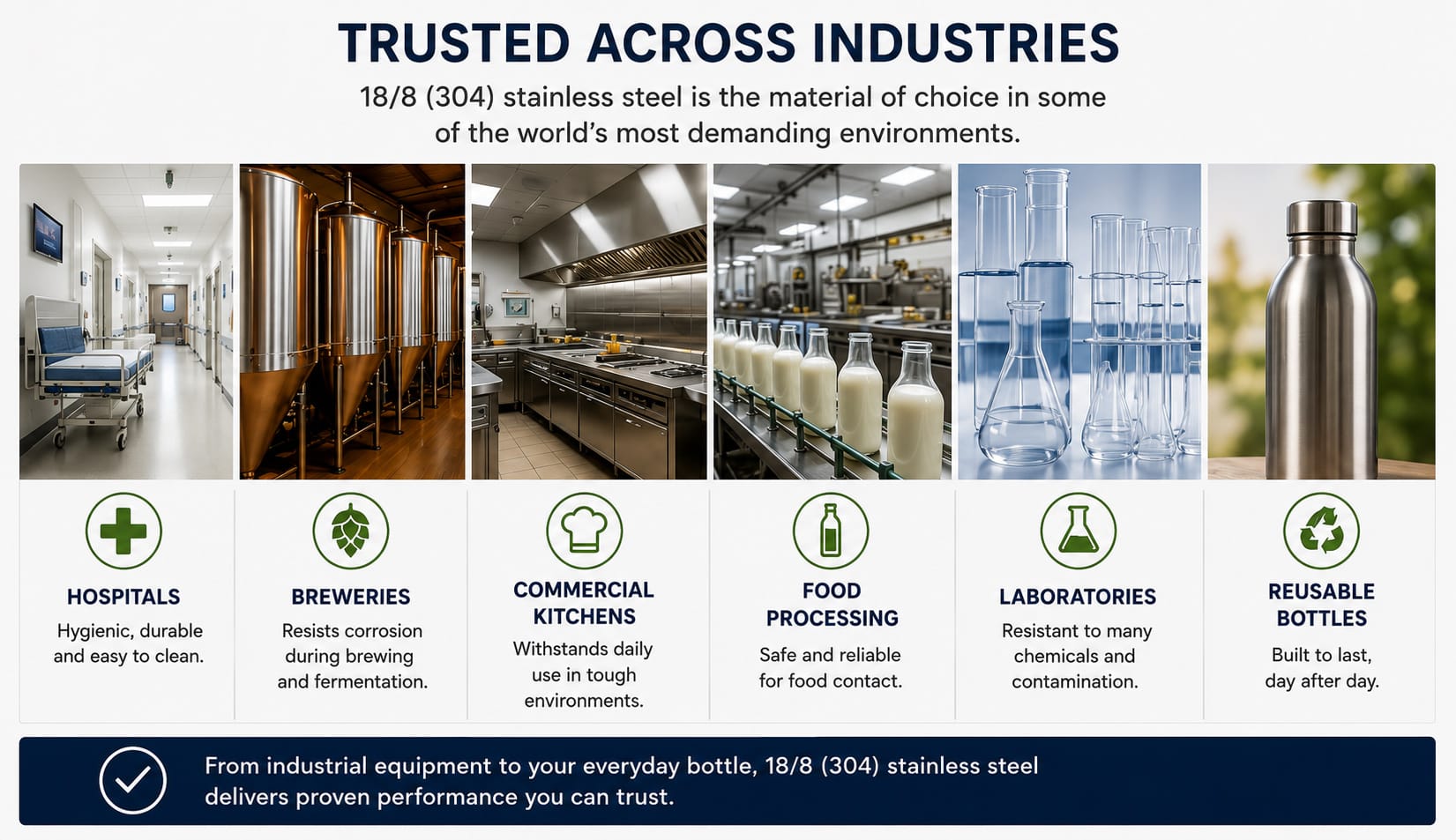
Today it is commonly used in:
- Commercial kitchens
- Food processing equipment
- Breweries and wineries
- Dairy processing plants
- Hospitals
- Medical equipment
- Pharmaceutical manufacturing
- Commercial water systems
- Laboratory equipment
When you use a bottle made from 18/8 (304) stainless steel, you're using the same family of material trusted across many of the world's most demanding industries.
304 vs 316 Stainless Steel
Many people assume that 316 stainless steel is automatically "better" than 304.
The reality is more nuanced.
Both are recognised food-grade stainless steels and are widely used in food processing, commercial kitchens, medical equipment and beverage applications.
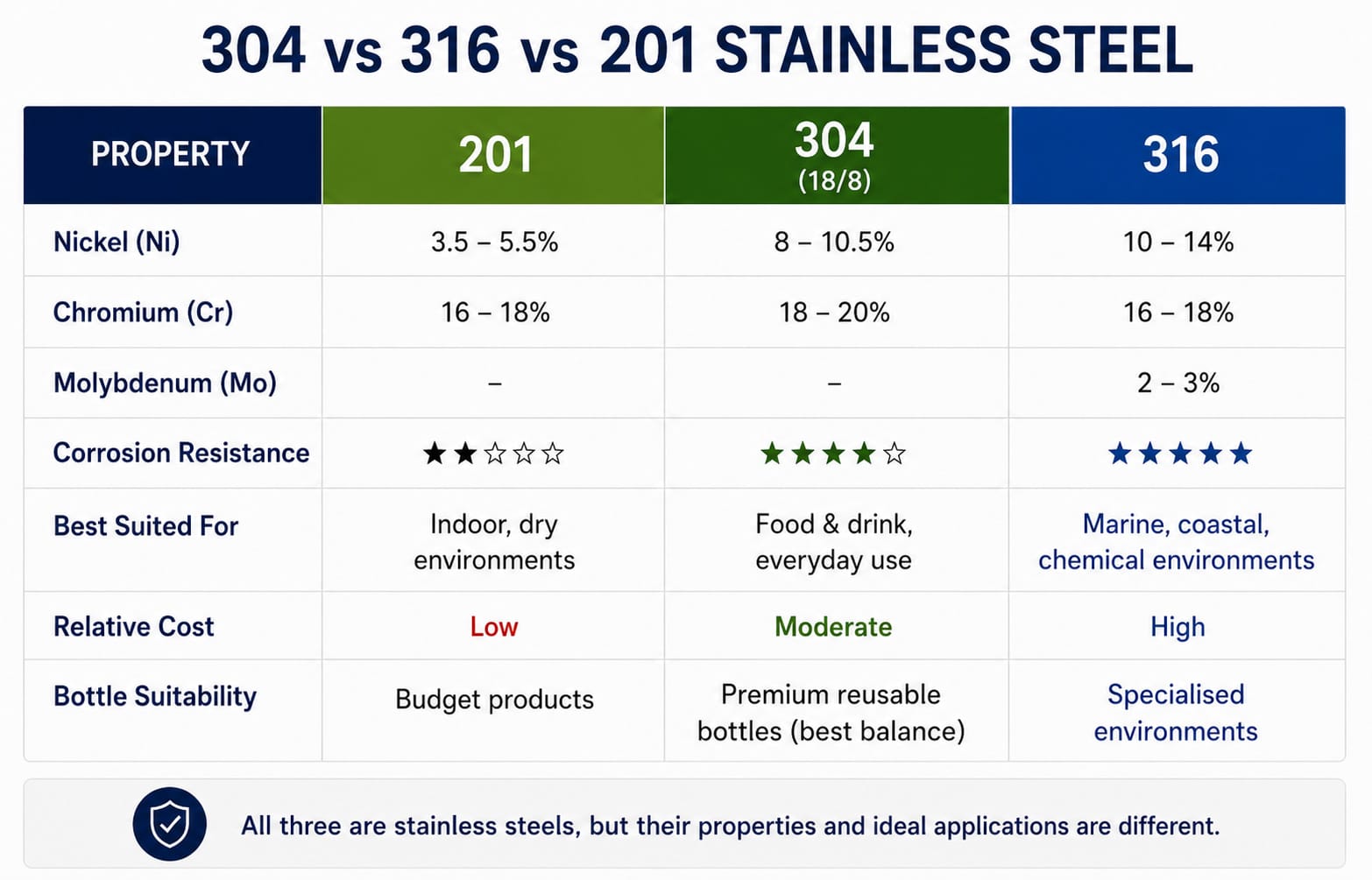
The key difference is that 316 stainless steel contains approximately 2–3% molybdenum, an additional alloying element that significantly improves resistance to chlorides, such as salt and seawater.
304 Stainless Steel
- Excellent corrosion resistance
- Outstanding food-contact performance
- Ideal for drinking water and everyday beverages
- Widely used around the world
- Excellent balance of performance and value
316 Stainless Steel
- Contains approximately 2–3% molybdenum
- Greater resistance to chlorides and marine environments
- Commonly used in coastal installations, chemical processing and medical applications
- Higher material cost
For everyday reusable drink bottles filled with water, tea or coffee, 304 stainless steel provides outstanding long-term performance.
Unless the bottle is being used continuously in highly corrosive marine, chemical or industrial environments, there is generally little practical advantage in choosing 316 over 304 for everyday hydration.
It is also worth noting that both 304 and 316 contain nickel. Although 316 generally offers greater corrosion resistance in harsh environments, it also contains slightly more nickel than 304. Under normal food-contact conditions, both grades release extremely low levels of metal ions because they are protected by their naturally occurring passive chromium oxide layer.
What About 201 Stainless Steel?
Another grade you may encounter is 201 stainless steel.
Unlike 304, 201 contains less nickel and more manganese.
This makes it less expensive to manufacture.
201 stainless steel is commonly found in:
- Budget cookware
- Household products
- Low-cost reusable bottles
- Decorative products
This does not automatically make 201 poor quality.
However, compared with 304, it generally offers:
- Lower corrosion resistance
- Reduced long-term durability
- Less resistance to harsh environments
Manufacturers often choose 201 because it reduces production costs.
Many premium reusable bottle manufacturers choose 304 because of its proven long-term performance.
Can Stainless Steel Rust?
One of the biggest misconceptions is that stainless steel can never rust.
In reality, no stainless steel is completely immune to corrosion.
The word stainless means highly resistant to staining and corrosion, not completely rust-proof.
Under normal everyday use, food-grade 18/8 (304) stainless steel performs exceptionally well for reusable drink bottles.
However, corrosion can occur when the protective passive layer is exposed to aggressive conditions for extended periods, including:
- Salt or seawater
- Chlorine bleach
- Chlorine-based cleaning products
- Strong acidic cleaners
- Industrial chemicals
- Long-term surface contamination
Fortunately, these environments are well outside the conditions experienced during normal everyday use.
What Is Tea Staining?
One of the most misunderstood forms of corrosion is something known as tea staining.
Despite its name, it has nothing to do with drinking tea.
Tea staining is a light brown or bronze discolouration that develops on the surface of stainless steel when the protective passive layer is challenged by aggressive environmental conditions.
It is most commonly associated with coastal and marine environments, where airborne salt accumulates on the surface over time. However, prolonged exposure to certain corrosive cleaning chemicals—including chlorine bleach, some chlorine-containing cleaning products, strong acidic cleaners, or other aggressive chemicals—may also contribute to surface staining or corrosion if the stainless steel is not properly rinsed and maintained.
Tea staining is generally considered an early, superficial form of corrosion. In most cases it is cosmetic rather than structural and does not indicate that the stainless steel has failed or is no longer suitable for use.
Even high-quality 304 stainless steel can develop tea staining when exposed to aggressive environments for extended periods.
This does not necessarily indicate poor-quality stainless steel.
In most cases, the staining can be removed by cleaning the surface with an appropriate stainless steel cleaner, followed by thorough rinsing and drying.
For structures permanently exposed to marine environments, engineers often specify 316 stainless steel because its added molybdenum provides improved resistance to chloride attack.
For reusable drink bottles used in everyday conditions, however, 304 remains the global standard because it provides an outstanding balance of corrosion resistance, durability, food safety and value.
Why Doesn't Everyone Use 304?
The answer is simple: cost.
Nickel is one of the more expensive alloying elements used in stainless steel production.
Reducing nickel content lowers manufacturing costs.
This is one reason some manufacturers choose 201 stainless steel instead.
Choosing 304 represents an investment in long-term performance rather than the lowest possible production cost.
Why ECOtanka Uses 18/8 (304)
At ECOtanka, we've used 18/8 (304) food-grade stainless steel since 2005.
We chose it because it offers an outstanding balance of:
- Corrosion resistance
- Long-term durability
- Food-contact safety
- Strength
- Proven performance
Combined with our coating-free bottle interiors, food-grade silicone seals and optional stainless steel lids, it provides a reliable foundation for bottles designed to last for many years.
Frequently Asked Questions
Is 316 stainless steel safer than 304?
No. Both are recognised food-grade stainless steels. 316 simply offers improved resistance to chlorides and marine environments.
Is 304 stainless steel food grade?
Yes. It is one of the world's most widely used food-contact stainless steels.
Is 201 stainless steel unsafe?
No. It is widely used in many products. However, it generally offers lower corrosion resistance than 304.
Can stainless steel rust?
Yes. Under extreme conditions any stainless steel can corrode, although 304 is highly resistant under normal everyday use.
What is tea staining?
Tea staining is a light brown surface discolouration that can occur in salty coastal environments. It is usually cosmetic and does not normally indicate structural failure.
The Bottom Line
18/8 (304) stainless steel didn't become the world's most widely used food-grade stainless steel by accident.
Its unique combination of chromium and nickel provides excellent corrosion resistance, durability and long-term performance that has been proven across industries ranging from hospitals and breweries to commercial kitchens and food manufacturing.
While other stainless steel grades each have their place, 304 has earned its reputation as the global standard for everyday food and beverage applications.
At ECOtanka, that's why we've trusted 18/8 (304) stainless steel for more than 20 years.
When you choose a quality reusable bottle made from 304 stainless steel, you're choosing a material trusted worldwide for its reliability, durability and performance.
Looking After Your Stainless Steel Bottle
Quality stainless steel requires very little maintenance, but a few simple habits will help keep your bottle looking its best for many years.
We recommend:
- Wash regularly using warm water and a mild dishwashing detergent.
- Rinse thoroughly after cleaning.
- Allow the bottle to dry before long-term storage.
- Avoid prolonged contact with chlorine bleach or harsh acidic cleaning products.
- If the bottle is used in coastal or marine environments, rinse away salt deposits occasionally.
- Avoid leaving highly corrosive substances inside the bottle for extended periods.
Following these simple steps helps maintain the natural passive chromium oxide layer that protects stainless steel from corrosion.
References
- World Stainless Association. Grades of Stainless Steel and Their Applications.
- ASM International. Properties and Selection: Irons, Steels, and High-Performance Alloys.
- ASTM International. Stainless Steel Standards.
- Association for Materials Protection and Performance (AMPP). Metal Release and Corrosion Resistance of Different Stainless Steel Grades in Simulated Food Contact.
- Nickel Institute. Stainless Steel and Food Contact Applications.
- International Molybdenum Association (IMOA). Tea Staining of Stainless Steels.
- European Stainless Steel Development Association (Euro Inox). Tea Staining of Stainless Steel.