Microplastics in Bottled Water: What Are You Really Drinking?
Microplastics and nanoplastics have been detected in bottled water. We examine research from 2018 to 2026, what scientists discovered, and where these tiny plastic particles may come from.
Part 2 of the ecotanka Microplastics Series
For decades, bottled water has been marketed around ideas of purity, freshness and convenience.
But when researchers began looking closely at bottled water, they found something most consumers were not expecting:
tiny particles of plastic.
And as scientific equipment has become capable of detecting smaller and smaller particles, the numbers being reported have changed dramatically.
Early studies counted hundreds of plastic particles per litre.
More recent research, capable of detecting nanoplastics, has reported hundreds of thousands of plastic particles in a single litre of bottled water.
So what is actually going on?
And importantly, where are these particles coming from?
The Study That Put Bottled-Water Microplastics in the Spotlight
In 2018, research commissioned by the journalism organisation Orb Media examined bottled water purchased around the world.
Scientists at the State University of New York at Fredonia analysed 259 bottles from 19 locations in nine countries, representing 11 different bottled-water brands.
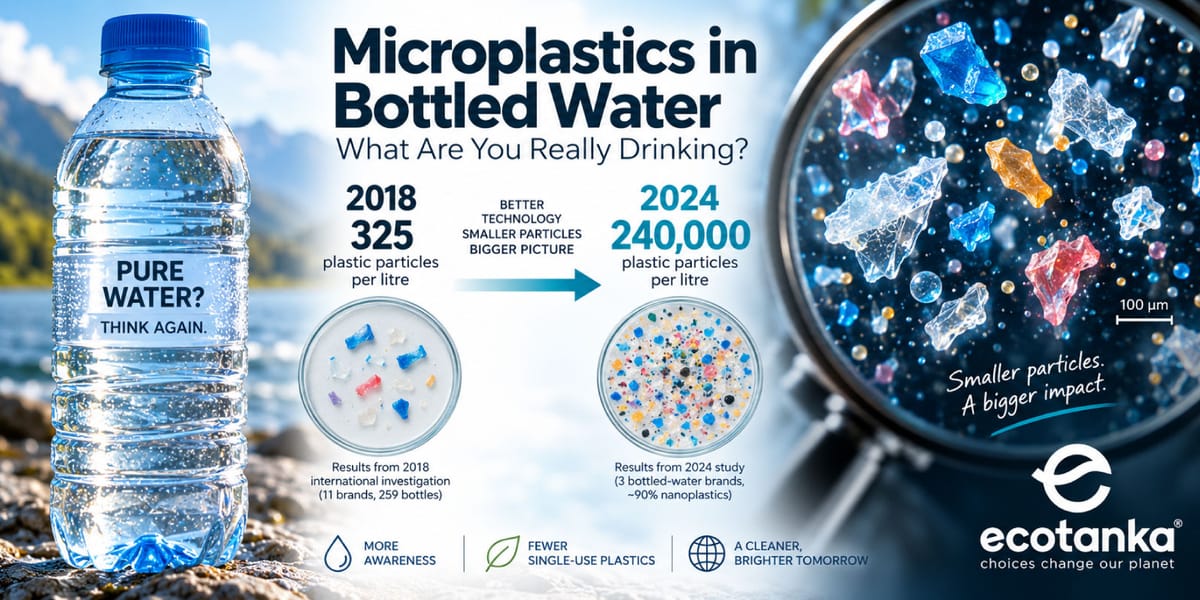
The investigation reported an average of 325 plastic particles for every litre of bottled water tested. Of the 259 bottles tested, only 17 were reported as showing no plastic contamination under the testing method used.
The brands included some of the largest names in bottled water:
Aqua, Aquafina, Bisleri, Dasani, Epura, Evian, Gerolsteiner, Minalba, Nestlé Pure Life, San Pellegrino and Wahaha.
Some individual samples contained far more particles than the average.
The infographic accompanying the research showed reported ranges extending as high as 10,390 particles per litre for samples of Nestlé Pure Life.
But another finding was particularly interesting.
What Types of Plastic Were Found?
According to the data from the investigation, polypropylene accounted for 54% of the identified plastic particles.
The breakdown was:
| PLASTIC IDENTIFIED | PERCENTAGE |
|---|---|
| Polypropylene | 54% |
| Nylon | 16% |
| Polystyrene | 11% |
| Polyethylene | 10% |
| Polyester / PET | 6% |
| Other plastics | 3% |
Why is polypropylene interesting?
Because polypropylene is widely used to manufacture bottle caps.
WHO subsequently noted that PET and polypropylene were among the polymers frequently detected in drinking-water studies and that bottles and caps themselves may potentially contribute microplastics to bottled water.
But There Was a Problem With the 2018 Research
This is an important part of the story.
The Orb Media investigation received enormous worldwide attention, but at the time it was reported, the bottled-water study had not been published in a scientific journal or undergone scientific peer review.
Some bottled-water manufacturers also challenged the methodology.
That doesn't mean the findings should simply be dismissed.
In fact, WHO later cited this work as one of the studies that initially stimulated scientific interest in microplastics in drinking water.
But it does mean that the famous 325 particles per litre figure shouldn't be treated as a universal measurement for all bottled water.
And there was an even bigger problem.
Scientists weren't yet seeing the smallest particles.
Then Scientists Started Looking for Nanoplastics
Microplastics are commonly defined as plastic particles smaller than 5 millimetres.
But plastic can break down much further.
Particles below approximately 1 micrometre are commonly referred to as nanoplastics.
These particles present a major analytical challenge simply because they are so small.
That means an important question emerged:
What if earlier studies were only counting the plastic particles large enough for their equipment to detect?
In 2024, researchers provided a striking answer.
2024: Around 240,000 Plastic Particles Per Litre
Researchers from Columbia University developed an advanced imaging technique capable of detecting and identifying extremely small plastic particles.
They applied the technique to three popular brands of bottled water.
Their results, published in the Proceedings of the National Academy of Sciences (PNAS) in January 2024, found an average of approximately:
240,000 detectable plastic particles per litre
Around 90% were nanoplastics.
That was approximately 10 to 100 times more plastic particles than previous estimates that had primarily measured larger microplastics.
That doesn't necessarily mean bottled water suddenly became more contaminated between 2018 and 2024.
It largely means:
Scientists became much better at seeing what was already extremely difficult to detect.
What Plastics Did the Researchers Find?
The 2024 researchers looked for seven major types of plastic.
All seven were detected.
One of the most abundant was polyamide, a type of nylon that can be used in water purification and filtration processes.
They also found significant amounts of polyethylene terephthalate — PET.
PET is, of course, the plastic widely used to manufacture disposable water bottles.
Other plastics detected included PVC, polystyrene and polymethyl methacrylate.
This tells us something important.
The bottle itself may be one source of plastic particles.
But it isn't necessarily the only source.
Plastic particles can potentially enter bottled water during water treatment, filtration, bottling, packaging, transport and handling.
Can the Bottle Itself Release Plastic?
Research increasingly suggests that it can.
This is where the story becomes particularly relevant to the way bottled water is used in everyday life.
Researchers tested eight leading US bottled-water brands under several storage and handling conditions, including high temperatures of 60°C, mechanical shaking at 200 rpm, and 15-day temperature cycling designed to simulate storage in vehicles or outdoors.
The highest release occurred when heat and shaking were combined, with measured nanoplastic concentrations increasing 9.29-fold under those experimental conditions. Freeze-thaw and high-temperature cycling also significantly increased nanoplastic concentrations.
Think about how bottled water is actually transported and stored.
Cases of water can spend time in warehouses.
They travel in trucks.
They may sit outdoors.
A bottle may be left inside a vehicle.
It gets picked up, carried, squeezed and shaken.
That doesn't mean every bottle subjected to those conditions will release exactly the same number of particles.
But the research demonstrates that storage and handling conditions matter.
Bottled Water Versus Tap Water
There is another interesting development.
A study published online in late 2025 and in the January 2026 issue of Science of the Total Environment directly compared micro- and nanoplastics in bottled water with conventionally treated drinking water.
More than half of the particles detected in both types of water were nanoplastics.
However, the researchers found that bottled water had higher particle concentrations than treated drinking water.
They concluded that previous studies likely underestimated micro- and nanoplastic concentrations because nanoplastics were often excluded from measurement.
That is an important development.
It doesn't mean every tap-water supply is better than every bottled-water product.
Water quality varies enormously according to location, source and treatment.
But it does challenge a common assumption:
Buying water in a plastic bottle doesn't automatically mean you're buying water with fewer plastic particles.
WHO had already observed in its earlier assessment that bottled-water studies tended to report higher particle numbers than tap-water studies, while cautioning that differences in analytical methods made direct comparisons difficult.
Where Do the Plastic Particles Come From?
There probably isn't one answer.
Research indicates several possible sources.
Some particles may already be present in the source water.
Others may be introduced through filtration and water-treatment processes.
Some may enter during bottling.
And some appear capable of being released from the bottle and its cap.
WHO specifically recognises plastic bottles and caps as possible sources of microplastics in bottled drinking water.
The different polymers detected by researchers support the idea that multiple sources may be involved.
PET can be associated with the bottle.
Polypropylene can be associated with caps.
Polyamide can be associated with filtration systems.
Other plastics may come from different parts of the production and packaging process.
So bottled-water microplastics are not simply a story about PET.
They are a story about an entire production, packaging and distribution system involving plastic materials.
Does This Mean Bottled Water Is Dangerous?
This is where we need to separate two questions.
Are microplastics and nanoplastics present in bottled water?
There is now substantial evidence that they can be.
Does drinking bottled water containing these particles cause disease?
That is a very different question.
WHO's assessment of nano- and microplastic exposure makes clear that substantial uncertainties remain concerning the implications for human health and that further research is required.
Finding a substance in drinking water does not, by itself, establish that the concentration detected causes harm.
That distinction is particularly important with nanoplastics because measurement technology and toxicological research are still developing.
We should therefore neither ignore the research nor exaggerate what it proves.
But We Can Reduce Unnecessary Plastic
Regardless of the unresolved health questions, there is another issue that doesn't require much uncertainty.
Disposable plastic water bottles create plastic waste.
WHO recommends reducing plastic use where possible and improving plastic management because reducing the amount released into the environment provides wider environmental benefits regardless of the unresolved questions surrounding microplastics and human health.
And this brings us back to something very simple.
If you already have access to suitable drinking water, do you need a new disposable plastic container every time you want a drink?
A reusable bottle doesn't magically remove microplastics that may already be present in the water you put into it.
That's important to acknowledge.
But choosing a durable reusable bottle can eliminate the need for repeatedly buying, using and disposing of single-use plastic water bottles.
Why ecotanka Uses Stainless Steel
ecotanka has manufactured reusable stainless steel drink bottles since 2005.
Our bottle bodies are made from 18/8 Type 304 stainless steel.
There is no plastic lining inside the bottle and no plastic coating between your drinking water and the stainless steel body.
Some ecotanka designs use polypropylene components in their lids and silicone seals, while stainless steel lid options are also available for selected products.
We believe that distinction matters.
We aren't claiming that using a stainless steel bottle makes microplastics disappear from drinking water.
It doesn't.
Instead, the idea is much simpler:
If a container doesn't need to be disposable, why make it disposable?
A durable reusable bottle can be refilled again and again rather than being discarded after a single use.
From 325 to 240,000: What Changed?
Looking back at the research gives us perhaps the most interesting lesson of all.
2018: The international bottled-water investigation reported an average of 325 plastic particles per litre.
2024: Researchers using technology capable of detecting nanoplastics reported approximately 240,000 detectable plastic particles per litre in the three bottled-water brands they examined.
2026: Researchers are now examining how ordinary storage, heat, shaking and temperature changes affect the release of nano- and microplastics from PET bottles.
The enormous difference between 325 and 240,000 shouldn't be interpreted simply as bottled water becoming hundreds of times more contaminated.
Our ability to detect extremely small particles has changed.
And that may be one of the most important lessons from the development of microplastics research.
The more closely scientists look, the more complicated the picture becomes.
The Bottom Line
Microplastics have been detected in bottled water for years.
New analytical techniques are now revealing something earlier research largely couldn't see:
nanoplastics.
Research published in 2024 detected around 240,000 micro- and nanoplastic particles per litre on average in three bottled-water brands, with approximately 90% being nanoplastics.
More recent research indicates that storage and handling conditions can also influence the release of particles from PET bottles.
Scientists are still working to understand what long-term exposure means for human health.
But from an environmental perspective, there is already a straightforward way to reduce one part of the problem:
use fewer disposable plastic bottles.
Not because a reusable stainless steel bottle can guarantee plastic-free water.
But because every disposable plastic bottle we don't need is one less plastic bottle that needs to be produced, transported and eventually discarded.
References & Further Reading
1. Qian N, Gao X, Lang X, et al. (2024).
Rapid single-particle chemical imaging of nanoplastics by SRS microscopy.
Proceedings of the National Academy of Sciences (PNAS), 121(3), e2300582121.
DOI: 10.1073/pnas.2300582121
This peer-reviewed study introduced the imaging technique used to identify approximately 240,000 micro- and nanoplastic particles per litre on average in the three bottled-water brands examined.
2. National Institutes of Health (NIH) (2024).
Plastic particles in bottled water.
NIH Research Matters, January 23, 2024.
Provides an accessible summary of the PNAS research, including the finding that approximately 90% of the detected plastic particles were nanoplastics and that all seven targeted plastic types were detected.
3. Hussain KA, Dong H, Tamayo-Aguilar A, et al. (2026).
Everyday storage and handling of PET bottled water increase human exposure to nano- and microplastics: Influence of socio-economic factors.
Water Research, Volume 295, 125569.
DOI: 10.1016/j.watres.2026.125569
The researchers tested eight leading US bottled-water brands and found that heat, shaking and temperature cycling influenced particle release from PET bottles. Combined heat and shaking increased detected nanoplastic concentrations approximately 9.29-fold under the experimental conditions.
4. World Health Organization (2019).
Microplastics in Drinking-Water.
World Health Organization, Geneva.
A major WHO assessment of the evidence surrounding microplastics in drinking water, their possible sources, water treatment and the uncertainties surrounding potential health effects.
5. World Health Organization (2022).
Dietary and inhalation exposure to nano- and microplastic particles and potential implications for human health.
World Health Organization, Geneva.
An updated WHO assessment considering human exposure to micro- and nanoplastics through food, water and air.
6. Orb Media / State University of New York at Fredonia (2018).
Plus Plastic: Microplastics Found in Global Bottled Water.
The international investigation analysed 259 bottles from 19 locations in nine countries across 11 brands. It reported an average of 325 particles per litre under its testing methodology. This investigation received extensive international coverage but had not undergone scientific peer review when originally reported.