How Safe is Stainless Steel?
Discover why food-grade stainless steel is trusted worldwide. Learn how chromium creates a self-healing protective layer that resists corrosion and helps make stainless steel one of the safest materials for reusable drink bottles.
The Science Behind One of the World's Most Trusted Food-Contact Materials
When people choose a reusable drink bottle, they often focus on what it's made from—but few stop to ask why certain materials are considered safe.
Stainless steel has been used for decades in hospitals, commercial kitchens, breweries, pharmaceutical manufacturing, dairy processing, and food production around the world. It is trusted not simply because it is strong or long-lasting, but because of a remarkable property that allows it to naturally protect itself from corrosion.
This self-protecting behavior is known as passivation, and it is one of the reasons high-quality food-grade stainless steel remains one of the safest materials available for reusable drink bottles.
What Makes Stainless Steel "Stainless"?
Despite its name, stainless steel isn't completely immune to corrosion. Instead, it has the unique ability to continuously protect itself.
The secret lies in one of its key ingredients: chromium.
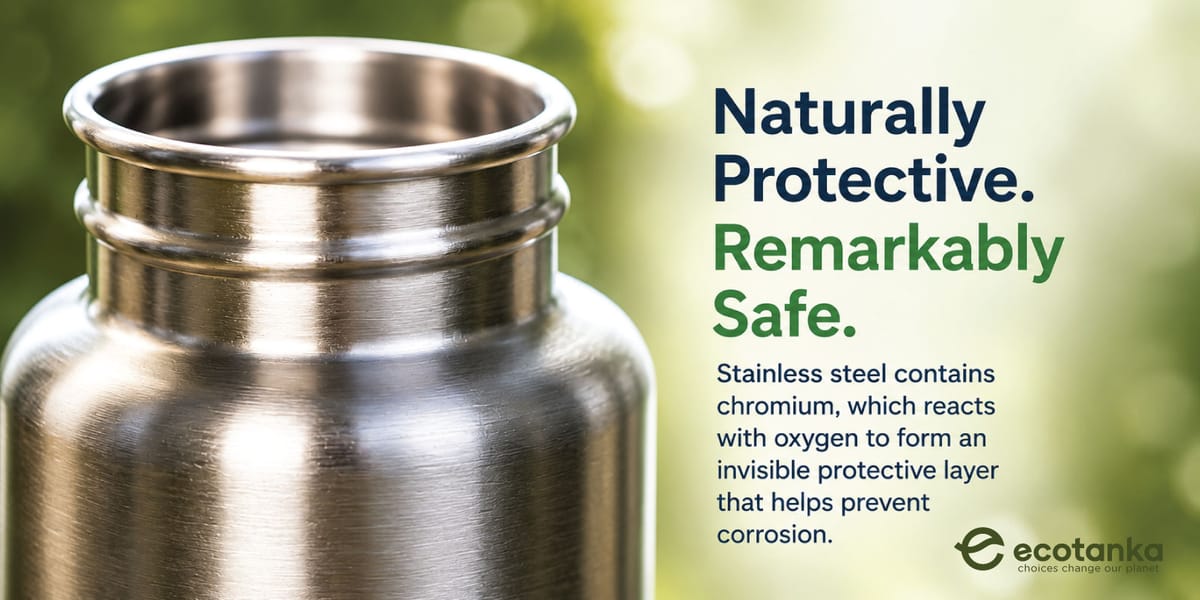
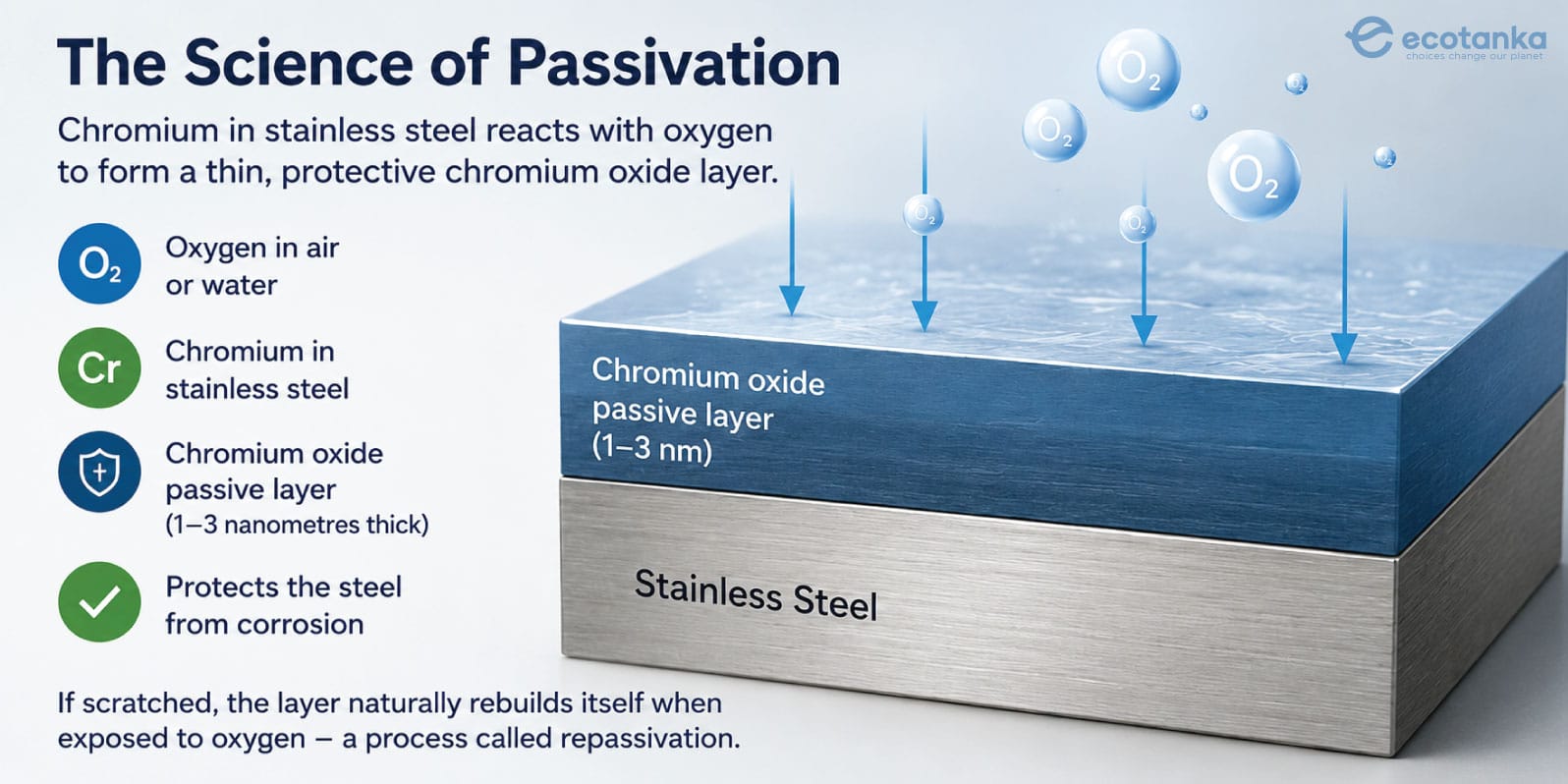
Food-grade stainless steel contains at least 10.5% chromium. When chromium comes into contact with oxygen in the air or water, it immediately reacts to form an incredibly thin protective layer called the passive chromium oxide film.
Although this protective layer is only around 1–3 nanometres thick—thousands of times thinner than a human hair—it forms a powerful barrier between the metal and its surroundings.
This invisible shield is what gives stainless steel its outstanding corrosion resistance.
The Amazing Self-Healing Property
One of the most fascinating characteristics of stainless steel is that this protective layer isn't permanent—it is constantly renewing itself.
If the surface becomes lightly scratched through normal everyday use, oxygen reacts with the exposed chromium and forms a new protective chromium oxide layer.
This natural rebuilding process is called repassivation.
Unlike painted surfaces or coatings that can chip or wear away permanently, stainless steel continually repairs its own protective surface whenever oxygen is available.
This is one of the reasons stainless steel remains highly resistant to corrosion even after years of regular use.
Why Does This Matter for Your Drink Bottle?
The passive chromium oxide layer doesn't simply keep stainless steel looking shiny.
More importantly, it protects the metal from reacting with water, beverages, and the surrounding environment.
Because the surface resists corrosion so effectively, it also helps minimise the release of metal ions under normal drinking conditions.
This is why high-quality food-grade stainless steel has become the material of choice for products that come into direct contact with food and beverages.
Trusted Around the World
The same stainless steel used in premium reusable drink bottles is also found in many industries where cleanliness, durability, and safety are essential.
These include:
- Food manufacturing equipment
- Commercial kitchens
- Dairy processing plants
- Breweries and wineries
- Pharmaceutical production
- Medical instruments
- Hospital equipment
- Laboratory facilities
- Water treatment systems
These industries rely on stainless steel because it combines excellent corrosion resistance with exceptional hygiene and long service life.
Does Stainless Steel Leach Chemicals?
This is a common question, and the answer deserves some context.
Under normal everyday use, high-quality food-grade stainless steel releases extremely low levels of metal ions.
The passive chromium oxide layer greatly reduces corrosion, which in turn minimises any release from the metal surface.
Like almost every material used for food contact, stainless steel is not completely inert under every imaginable condition.
Extreme environments—such as prolonged exposure to strong acids, concentrated bleach, or highly corrosive industrial chemicals—can damage the passive layer and increase corrosion.
However, these conditions are far removed from normal everyday use as a reusable drink bottle.
For drinking water, tea, coffee, and most everyday beverages, food-grade stainless steel performs exceptionally well and has earned its reputation as one of the safest food-contact materials available.
Why 18/8 (304) Stainless Steel?
Not all stainless steels are identical.
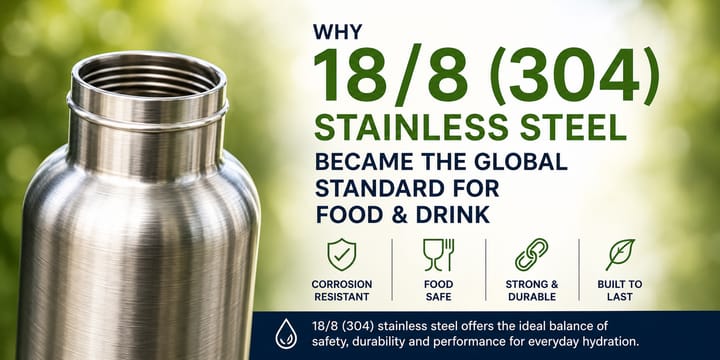
At ECOtanka, our bottles are made from 18/8 food-grade 304 stainless steel, one of the most widely used stainless steel grades in food and beverage applications.
The term 18/8 refers to its composition:
- Approximately 18% chromium
- Approximately 8% nickel
This combination provides excellent corrosion resistance, durability, and long-term performance while allowing the protective passive layer to continually regenerate.
It is the same family of stainless steel trusted worldwide for food preparation equipment, commercial kitchens, beverage processing, and countless everyday household products.
More Than Just Corrosion Resistance
The benefits of stainless steel extend well beyond durability.
Because there are no internal plastic liners or epoxy coatings inside an ECOtanka bottle, your water comes into contact only with smooth food-grade stainless steel.
Combined with our food-grade silicone seals and optional stainless steel lids, our bottles are designed to reduce unnecessary contact with plastics while providing a durable solution built to last for years.
Rather than relying on disposable bottles that require continual replacement, stainless steel offers a reusable alternative designed for decades of everyday use.
A Material Designed to Last
One of the most sustainable products is often the one that doesn't need replacing.
Unlike many materials that degrade with repeated use, quality stainless steel maintains its strength, appearance, and corrosion resistance year after year.
The same passive layer that protects against corrosion also contributes to the exceptional longevity for which stainless steel is known.
Many stainless steel products remain in service for decades, making them an excellent long-term investment for both people and the environment.
The Bottom Line
Stainless steel has earned its place as one of the world's most trusted food-contact materials through decades of scientific research and real-world use.
Its unique chromium-rich passive layer continuously protects the metal from corrosion, while its natural ability to repassivate allows the protective surface to rebuild itself after minor scratches.
For everyday drinking, high-quality food-grade stainless steel offers an outstanding combination of durability, hygiene, corrosion resistance, and safety.
At ECOtanka, that's one of the reasons we've trusted 18/8 food-grade stainless steel since 2005.
When choosing a reusable drink bottle, it's reassuring to know that the material protecting your water is also protecting itself.
References
- Marcus, P., et al. Passivation mechanisms and pre-oxidation effects on model surfaces of FeCrNi austenitic stainless steel. Corrosion Science.
- Association for Materials Protection and Performance (AMPP). Metal Release and Corrosion Resistance of Different Stainless Steel Grades in Simulated Food Contact. https://content.ampp.org/corrosion/article/72/6/775/1720/Metal-Release-and-Corrosion-Resistance-of
- National Institutes of Health (NIH). Stainless Steel Technical Bulletin. Office of Research Facilities. https://orf.od.nih.gov/TechnicalResources/Documents/Technical%20Bulletins/16TB/Stainless%20Steel%20October%202016%20Technical%20Bulletin_508.pdf
- Corrosion Science. The mechanism of oxide film formation on austenitic stainless steels in high temperature water. https://www.sciencedirect.com/science/article/pii/S0010938X97001406
- ASTM International. Stainless Steel Standards. https://www.astm.org
- International Stainless Steel Forum (ISSF). Stainless Steel in Food Contact Applications. https://www.worldstainless.org