BPA-Free Doesn't Mean Safe: The Rise of BPS and BPF
Think BPA-free means safe? Research suggests many products now use BPS and BPF instead. Learn why material choice still matters.
For years, consumers were told they had a simple way to avoid a controversial chemical: buy products labelled BPA-Free.
It sounded reassuring.
Manufacturers removed Bisphenol A (BPA) from water bottles, baby bottles, food containers, and countless other plastic products. Governments introduced restrictions. Retailers promoted BPA-Free products as the safer alternative.
Most people assumed the problem had been solved.
It wasn't.
In many cases, BPA wasn't eliminated. It was replaced.
The chemicals that followed—primarily Bisphenol S (BPS) and Bisphenol F (BPF)—are now found throughout modern consumer products, often carrying the same BPA-Free label that helped drive their adoption.
The question consumers should be asking isn't whether a product is BPA-Free.
The question is: what replaced it?
The Chemical That Changed the Conversation
When ecotanka was founded in New Zealand in 2005, concerns about plastic bottles were already growing.
Much of that concern centred around BPA, a chemical commonly used in polycarbonate plastics and epoxy resins. It could be found in sports bottles, food containers, baby bottles, and the linings of many food and beverage cans.
Researchers were becoming increasingly concerned about BPA's ability to behave like a hormone inside the human body.
BPA is classified as an endocrine-disrupting chemical. Its molecular structure is similar enough to oestrogen that it can interact with hormone receptors and interfere with normal biological processes.
This wasn't simply a theoretical concern.
A review of 115 published animal studies examined by the Institute for Agriculture and Trade Policy reported that 81% found significant effects associated with low-level BPA exposure. Reported findings included altered reproductive development, decreased testosterone production, reduced sperm counts, enlarged prostate tissue, and behavioural changes.
As evidence accumulated, concern spread beyond academic circles.
Researchers detected BPA in blood, urine, umbilical cord blood, and amniotic fluid. A 2007 review published in Reproductive Toxicology concluded that humans were already being exposed to BPA at levels that exceeded those shown to cause harm in laboratory animals.
In 2010, a study of Chinese factory workers found that individuals with higher BPA exposure were more than three times as likely to experience reduced sperm concentration and lower sperm vitality.
Regulators began responding.
Canada declared BPA toxic.
The European Commission banned BPA in baby bottles.
Major manufacturers quietly removed BPA from many products.
From the outside, it looked like a public health victory.
But something else was happening behind the scenes.
The BPA-Free Revolution
Consumer pressure had made BPA commercially toxic.
Manufacturers needed a replacement.
The solution was not to move away from bisphenols altogether.
Instead, many companies switched to chemically similar alternatives, particularly BPS and BPF.
Products could now carry a BPA-Free label while continuing to use other members of the same chemical family.
Consumers largely assumed BPA-Free meant safer.
The science had not yet caught up.
Unlike BPA, the replacement chemicals entered widespread use without decades of public scrutiny, extensive regulatory attention or comprehensive long-term testing.
The result was one of the largest chemical substitutions in modern consumer products.
And most consumers never noticed it happening.
The Evidence Begins to Appear
The first warning signs emerged surprisingly quickly.
In 2012, researchers analysing urine samples from the United States and seven Asian countries found detectable BPS in 81% of samples tested.
The highest concentrations were found in countries that had aggressively moved away from BPA.
The contamination hadn't disappeared.
It had simply changed names.
Further studies raised additional concerns.
Researchers at the University of Texas Medical Branch reported that extremely small concentrations of BPS—measured in parts per trillion—were capable of disrupting normal cellular signalling pathways. Their work linked BPS exposure to biological mechanisms associated with obesity, diabetes, asthma, birth defects, and certain cancers.
Cheryl Watson, one of the study's researchers, summarised the situation bluntly:
"They put BPA-Free on the label, which is true. The thing they neglected to tell you is that what they've substituted for BPA has not been tested for the same kinds of problems that BPA has been shown to cause."
Researchers at the University of Calgary observed that zebrafish embryos exposed to environmentally relevant concentrations of BPS experienced dramatic increases in neuronal growth and later displayed hyperactive behaviour.
Researchers at the University of Cincinnati found that both BPA and BPS could trigger heart rhythm abnormalities in female laboratory animals at exposure levels comparable to those found in humans.
The similarities were becoming difficult to ignore.
The replacement chemicals were behaving in ways that looked remarkably familiar.
The False Promise of BPA-Free
Perhaps the most revealing development came from the BPA-Free certification movement itself.
The BPA-Free Package certification program eventually shut down.
Its organisers concluded that the certification had unintentionally created what they described as a "false halo of health."
The label had succeeded in reassuring consumers.
It had not necessarily succeeded in making products safer.
That distinction matters.
A BPA-Free label tells consumers only one thing:
BPA is not present.
It does not tell consumers whether BPS is present.
It does not tell consumers whether BPF is present.
It does not tell consumers whether replacement chemicals have undergone equivalent long-term safety evaluation.
And it certainly does not mean a product is free from endocrine-disrupting chemicals.
What the Latest Research Shows
The most recent research suggests the problem may be growing rather than shrinking.
A 2025 peer-reviewed analysis estimated that bisphenol-related metabolic disease—including obesity, type 2 diabetes and metabolic syndrome—had increased from approximately 68 million cases globally in 2000 to 127 million cases by 2024.
The estimated economic burden exceeded USD $1.1 trillion in 2024 alone.
Perhaps more importantly, the researchers found that BPA restrictions had successfully reduced BPA exposure.
But the reduction was accompanied by substantial increases in exposure to BPS and BPF.
BPA levels declined.
BPS levels increased.
BPF levels increased.
The overall bisphenol burden shifted rather than disappeared.
By 2024, the majority of the estimated disease burden associated with bisphenol exposure was linked to the replacement chemicals rather than BPA itself.
Researchers increasingly refer to this phenomenon as a regrettable substitution—the replacement of one problematic chemical with another that later raises similar concerns.
Why ecotanka Chose a Different Path
At ecotanka, we never viewed BPA as the core issue.
The issue was always dependence on plastic.
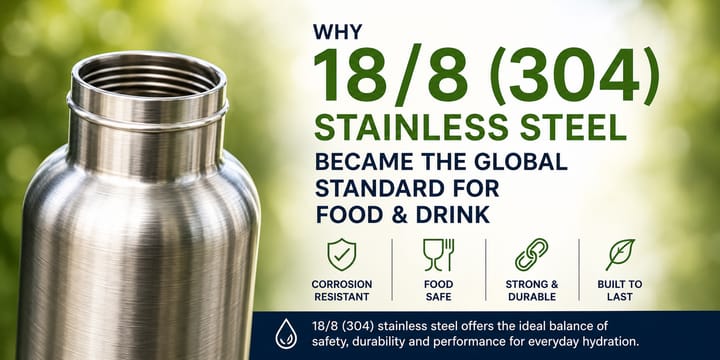
That is why our bottles have always been manufactured from pure 18/8 304 food-grade stainless steel.
No plastic interior.
No epoxy lining.
No hidden coatings.
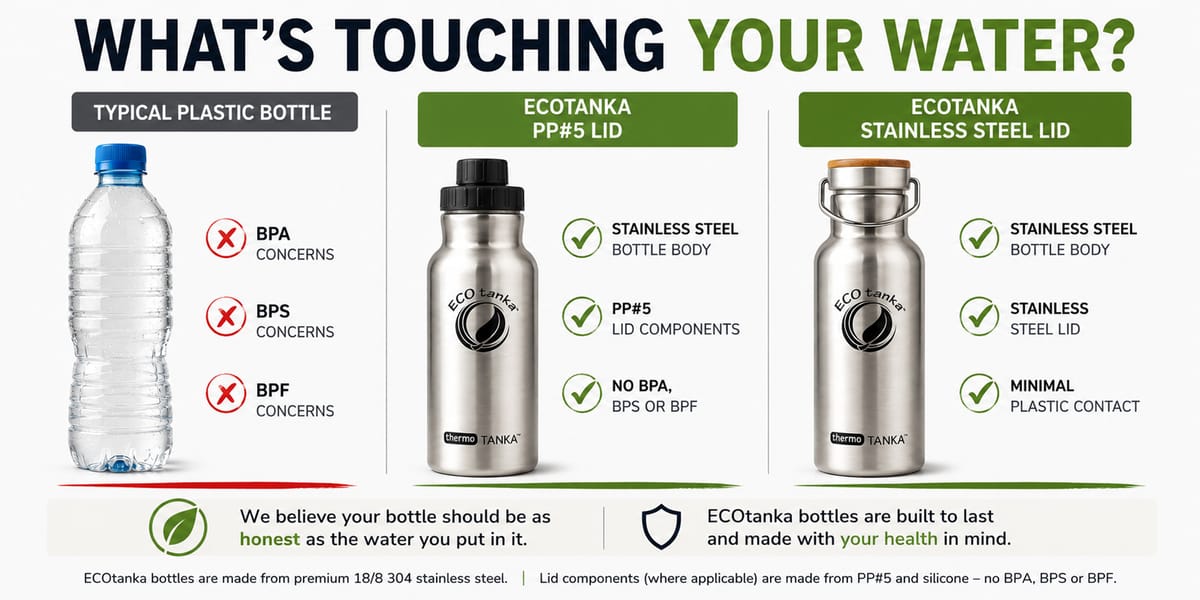
When water is stored inside an ecottanka bottle, it comes into contact with stainless steel—not polycarbonate, not BPA, not BPS, and not BPF.
Where plastic components are required, we use polypropylene (PP#5) rather than polycarbonate. Our seals are food-grade silicone sourced from a specialist German supplier.
These decisions were made when the company was founded in 2005.
We have not needed to change them because the materials themselves have not changed.
There was no BPA to replace.
There was no need for a BPA-Free marketing campaign.
The solution was already there.
The Bottom Line
The BPA story is often presented as a success story.
In some respects, it is.
Public awareness drove regulatory action. Manufacturers responded. BPA use declined.
But the story didn't end there.
In many cases, BPA was replaced by closely related chemicals that are now attracting their own scientific scrutiny.
That is why BPA-Free should never be confused with chemical-free.
And it is why material choice still matters.
Stainless steel has been used safely for generations.
It does not require a replacement chemical every decade.
It does not depend on changing labels.
And it does not require consumers to keep up with the latest acronym.
Your bottle should be as honest as the water you put in it.
Aaron Broderick
Founder, ECOtanka
Since 2005
Sources
1. Institute for Agriculture and Trade Policy (IATP)
Review of 115 published animal studies examining low-dose BPA exposure, as referenced by Dr I.J. Bullen in the Balya Cancer Self Help and Wellness Newsletter.
2. vom Saal FS, et al. (2007)
"Chapel Hill Bisphenol A Expert Panel Consensus Statement: Integration of Mechanisms, Effects in Animals and Potential to Impact Human Health at Current Levels of Exposure."
Reproductive Toxicology, 24(2), 131–138.
3. Li DK, Zhou Z, Miao M, et al. (2010)
"Urine Bisphenol-A Level in Relation to Semen Quality."
Fertility and Sterility, 95(2), 625–630.
4. European Commission (2010)
Decision to prohibit Bisphenol A in the manufacture of infant feeding bottles within the European Union.
5. Liao C, Liu F, Guo Y, et al. (2012)
"Bisphenol S in Urine from the United States and Seven Asian Countries: Occurrence and Human Exposures."
Environmental Science & Technology, 46(12), 6860–6866.
6. Watson CS, et al. (2013)
Research demonstrating the biological activity of Bisphenol S at extremely low concentrations and its ability to disrupt cellular signalling pathways.
7. Scientific American (2014)
"BPA-Free Plastic Containers May Be Just as Hazardous."
Coverage of emerging evidence surrounding BPS and other BPA replacements.
8. Kinch CD, Ibhazehiebo K, Jeong JH, et al. (2015)
Research from the University of Calgary shows altered brain development and hyperactive behaviour in zebrafish exposed to environmentally relevant concentrations of BPS.
9. Gao X, Wang HS (2014)
Research from the University of Cincinnati demonstrates that both BPA and BPS may disrupt cardiac electrical activity and increase susceptibility to arrhythmias in laboratory animals.
10. BPA-Free Package Certification Program
Program closure statement describing BPA-Free certification as creating a "false halo of health."
11. Quantifying the Metabolic Health Burden of Increased BPA/BPF/BPS Endocrine-Disrupting Chemical Exposure: A Temporal and Cross-Country Comparative Analysis from 2000 to 2024 (2025)
Peer-reviewed analysis estimating global health and economic impacts associated with BPA, BPS and BPF exposure.
12. Recent Reviews on Regrettable Substitutions (2025)
Reviews examining BPS and BPF as examples of "regrettable substitutions" where replacement chemicals may present risks comparable to those they replaced.
Editorial Note: This article is intended for educational purposes and is based on published scientific literature, regulatory findings, and peer-reviewed research available at the time of writing. Scientific understanding continues to evolve as new evidence emerges.