Why Stainless Steel? The Science Behind Our Bottles
PET plastic bottles leach antimony into your water — increasing 250x over 6 months. Discover why ecotanka has used pure stainless steel with no plastic interior since 2005.
A Study That Changed the Conversation
In 2006, researchers at Heidelberg University published a study examining antimony levels in bottled water from Canada and Europe.
What they found was significant.
Water stored in PET plastic bottles contained substantially higher levels of antimony than the original source water. The researchers concluded that antimony was migrating from the PET containers into the water during storage.
The longer the water remained in the bottle, the higher the measured concentrations became.
The study was published in the Journal of Environmental Monitoring and remains one of the most widely cited investigations into antimony migration from PET plastic bottles. The lead researcher, Dr William Shotyk, subsequently stated that he would no longer drink water from plastic bottles.
What is Antimony?
Antimony is a naturally occurring trace element that is commonly used in the manufacture of PET (polyethylene terephthalate) plastic.
PET is the clear plastic used in most bottled water, soft drinks, and juice bottles worldwide.
Approximately 90% of PET produced globally uses antimony trioxide as a catalyst during manufacturing.
Because of its widespread use, researchers wanted to understand whether any of this material could migrate from the bottle into the liquid it contains.
What the Researchers Found
The Heidelberg study compared pristine groundwater, source water, and commercially bottled water.
The results showed:
- Pristine groundwater contained approximately 2.2 parts per trillion (ppt) of antimony.
- Bottled water stored in PET containers averaged approximately 156 ppt.
- Water collected directly from a bottling source contained approximately 3.8 ppt before bottling.
- The same water measured approximately 359 ppt after being bottled in PET.
- After six months of storage at room temperature, concentrations increased to over 630 ppt — more than 250 times the natural level found in pristine groundwater.
The researchers concluded that antimony was leaching from PET bottles into the water they contained.
They also observed that concentrations increased with storage time, suggesting that the interaction between the bottle and its contents continued after bottling.
An Important Point
The researchers were careful to note that all of the bottled waters tested remained below drinking water guideline limits in place at the time of the study.
However, they also recommended further investigation because antimony concentrations increased during storage and appeared to originate from the PET container itself.
For many consumers, this raised a simple question:
If a bottle can contribute measurable substances to the water it contains, is there a better alternative?
Why We Chose Stainless Steel
At ecotanka, we believe the best bottle material is the one that adds as little as possible to your water.
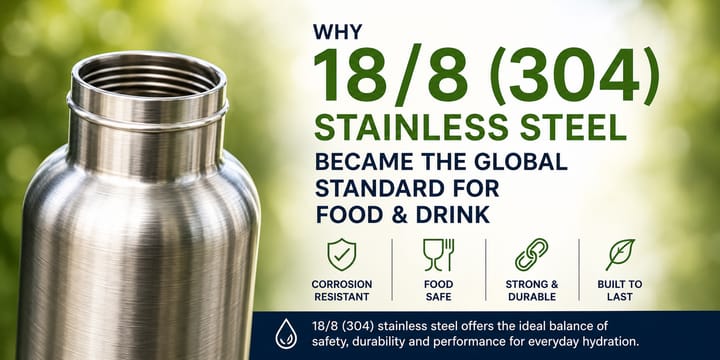
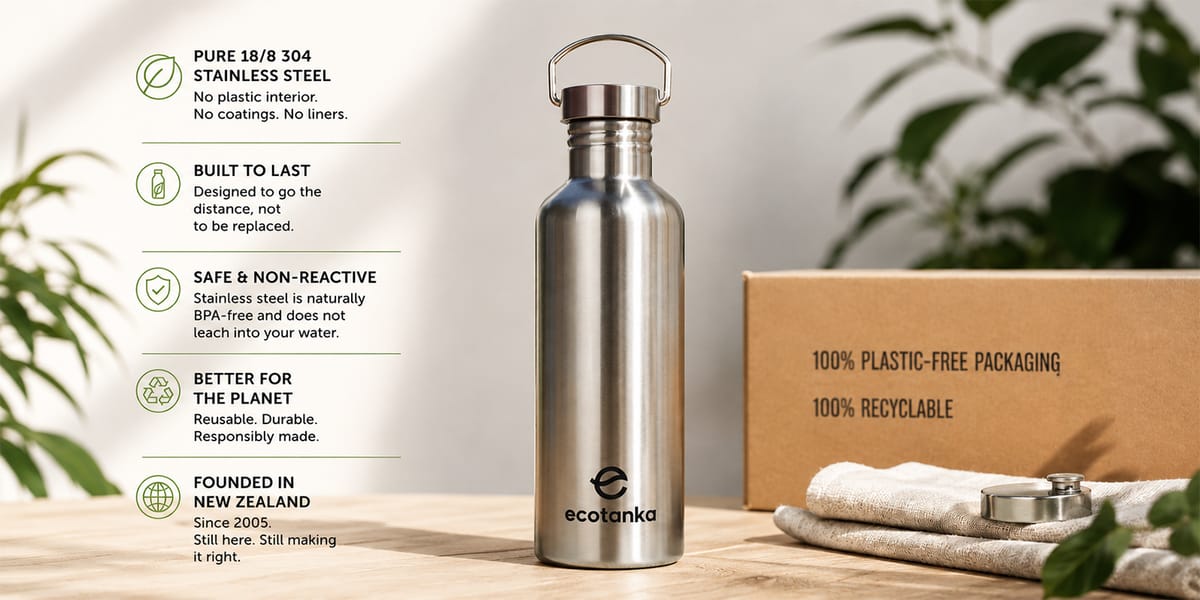
That's why every ecotanka bottle is made from pure 18/8 304 food-grade stainless steel.
No plastic interior.
No epoxy lining.
No internal coatings.
Just food-grade stainless steel between you and your water.
Unlike single-use plastic bottles, stainless steel does not require antimony-based PET manufacturing, and it does not rely on plastic liners to separate your water from the container.
Our goal has always been simple:
Keep your water as close as possible to the way it was when you filled the bottle.
Why ecotanka Exists
ecotanka was founded in New Zealand in 2005, around the same time that researchers were beginning to draw greater attention to the interaction between plastics and the products they contain.
Our response was straightforward.
Create a reusable bottle that avoids plastic contact with drinking water wherever possible, lasts for years rather than months, and reduces the need for disposable packaging.
Twenty years later, that mission hasn't changed.
Built for the Long Term
Many of our customers are still using ecotanka bottles purchased more than a decade ago.
Replacement parts are available, helping extend the life of the bottle rather than replacing it.
Our product packaging is also 100% plastic-free and fully recyclable across the entire range.
Because sustainability shouldn't stop at the bottle itself.
The Simple Choice
You can't control everything. But you can control what your water sits in before it reaches your lips.
Pure 18/8 304 food-grade stainless steel. No plastic interior. No coatings. No liners. Built to last for decades — our customers prove it.
Beyond the Bottle
At ecotanka, we don't just think about the bottle body.
We think about every component that comes into contact with your water.
That's why our bottles are made from pure 18/8 304 food-grade stainless steel with no internal coatings or liners.
Our plastic lids are manufactured using polypropylene (PP #5), not PET plastic.
Our seals are made from high-quality food-grade silicone sourced from a specialist German supplier.
Why does this matter?
Because when people choose stainless steel, they're often trying to reduce unnecessary contact between their water and plastic materials. We believe transparency matters, which is why we're open about the materials we use.
No hidden linings.
No PET plastic in our lids.
No mystery materials.
Just carefully selected components designed for durability, safety, and long-term use.
Research reference: Shotyk W, Krachler M, Chen B. Contamination of Canadian and European bottled waters with antimony from PET containers. J Environ Monit. 2006;8(2):288-92. DOI: 10.1039/b517844b
Publication:
Contamination of Canadian and European bottled waters with antimony from PET containers - Journal of Environmental Monitoring (RSC Publishing)
rsc_em_b517844b 288..292